George Angus suggests moving to products per retail delivery to measure F&I performance. The metric focuses on product sales and leaves out reserve.
5 min to read
One of the indicators we have used over the years when monitoring F&I performance is products sold per retail delivery (PPR). The measurement divides the number of products sold in the F&I department by the number of retail deals delivered. Why is this important? Because this measure of F&I performance doesn’t count finance reserve as a product.
Under the PPR measure, a dealership that delivers 100 retail units and sells 150 F&I products would have a PPR of 1.5. Products included in that count would include protections like credit insurance, GAP, service contracts, theft, tire-and-wheel protection, windshield protection and whatever else appears on the dealership’s menu.
Ad Loading...
Over the years, my firm has viewed this measurement as what we call a “casual” indicator of F&I performance. The outcome can vary from dealer to dealer based upon the products they offer. But we do believe it is a useful indicator when testing F&I processes.
The Big Threat For decades, F&I managers have measured their success by their profit per retail unit (PRU). Problem is, that measure doesn’t tell the full story of an F&I operation.
Take two separate F&I departments: Both operations are posting a PRU of $1,200. One dealership, however, is averaging 1.8 products per retail unit, while the other is averaging 0.8. That’s a significant difference, wouldn’t you agree?
See, both F&I departments can claim to be at $1,200 PRU, but the PPR clearly indicates that one of those stores is relying on finance reserve for a much larger percentage of the department’s income. I can certainly go into a long diatribe about the reasons the dealer with a 1.8 PPR is going to have better overall performance, but let’s save that debate for another time.
The reason you might want to start looking at your PPR is because we may be seeing more and more limits on finance reserve in the near future. Currently, there is a concerted effort by some very influential consumer groups to have the government limit finance reserve.
Ad Loading...
There’s the Center for Responsible Lending, a nonprofit organization and powerful lobbying group that fights predatory lending practices as a primary mission. Just check out this statement the organization made in March: “The Center for Responsible Lending believes that the ability of automobile dealers to add to a consumer’s interest rate for compensation when financing a vehicle for a consumer can and should be considered unfair and deceptive. The effects of competition in the market should benefit the consumer, and should be based on true competitive forces instead of perverse incentives. The only effective way to ensure effective competition is to prohibit dealer compensation that varies based on the interest rate or other material terms of the loan other than the principal balance of the loan.”
And all you have to do is look up the word “perverse” to understand the group’s attitude toward dealers. But that’s not all. During the Federal Trade Commission (FTC)’s three roundtable events last year — which the agency used to gather information about auto financing — six powerful advocacy groups filed a joint statement requesting that the FTC prohibit dealer participation.
“The FTC should write regulations banning dealer interest rate markups in the same way that the Federal Reserve and Congress in the Dodd-Frank Act have dealt with a similar issue of compensation in mortgage lending. These rules were the product of significant study of mortgage loan compensation practices and the impact certain compensation can have on consumers ... The findings and substance of the rule have a direct bearing on the issue of car dealer interest rate markups,” their statement read.
The bottom line is we are very likely to see increasing pressure to limit or outright eliminate finance reserve. Many of you are already seeing your lenders trying to limit your reserve. They are doing this voluntarily to try to stave off restrictive regulation.
Of course, some dealer associations and others are trying to make the case against this action, but as we have seen in other areas, the consumer groups have tremendous influence with the current administration and regulatory bodies.
Ad Loading...
Consumer advocates are after dealer reserve, which means the industry is likely to see increased pressure to limit or outright limit it as an income source.
Resistance Is Futile We can shake our fists at the sky and spend all day arguing that finance reserve is a perfectly reasonable cost; that we get those buy rates because of the volume of business we do and should get the benefit of the huge investment it takes to operate; that consumers still get better rates from dealers than other lenders; and that we can’t run a finance department, meet all of the regulatory requirements already handed down, and then have to offer those low rates for no profit.
Unfortunately, those arguments are falling on deaf ears in the consumer-protection world. This stuff simply isn’t going away, so it might be a good idea for you to start reviewing your processes to move away from finance reserve and to focus more on product sales as a larger percentage of your income.
That’s what we’re doing here at Team One with our “Package Option” process, and our customers are looking a lot more like that 1.8 PPR dealer than the 0.8 PPR store. And that’s because our process focuses more on product sales than finance reserve.
F&I professionals might want to start looking at PPR as a yardstick, not only because of the current regulatory environment, but as an indicator of a well-balanced, top-performing process. When you get a minute, calculate your PPR from last month and see where your numbers fall. If that number is less than one, you might want to start looking at your process to see how you can raise that number.
George Angus is the training director for Team One Research and Training. He will talk more about PPR during his workshop session at Industry Summit on Tuesday, Sept. 11, at 4:30 p.m. E-mail him at george.angus@bobit.com.
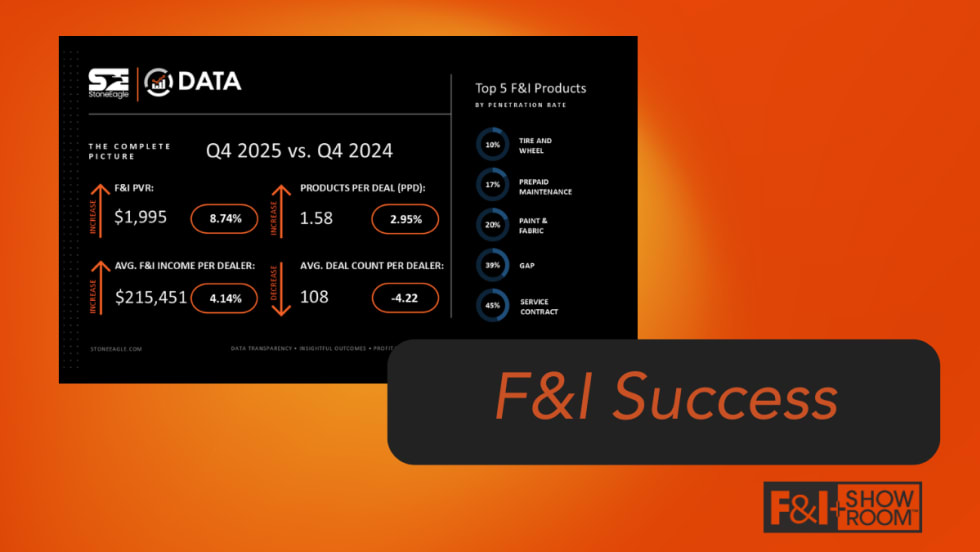
Deal volume ebbed and flowed throughout 2025, but product performance remained steady, according to automotive technology and data intelligence solutions provider StoneEagle.
A TransUnion study found that relationship-driven sales models proved to be important, as consumers who used an agent had a lower shopping intensity than those going it alone.
In this video, Reese Dailey of the Automotive Training Academy by Assurant reveals strategies to make cash deals profitable without relying on monthly payment bumps.
Suite of new APIs, product enhancements and integrations is designed to help maximize contracting and funding efficiency for lenders and their dealer partners.
December brought some of the best borrowing availability for consumers in years, though lenders tightened their reins on riskier segments of the market.
In this video, Reese Dailey of the Automotive Training Academy by Assurant explains how to handle a customer who isn’t willing to listen to your pitch.
Third-quarter battery electric vehicle insurance claims were up 4% year-over-year. A new report says EV claims cost the most due to complex technology and limited after-market parts supply.