One F&I insider says there’s more to the subprime pullback than the recent uptick in delinquencies. He says regulators are the real reason finance sources are so risk-averse.
So what’s really behind the subprime pullback? Are finance sources being more responsible? Could it be that we are eight years and about three months into the current economic expansion, and only one expansion in the last 50 years lasted longer than eight years and one month?
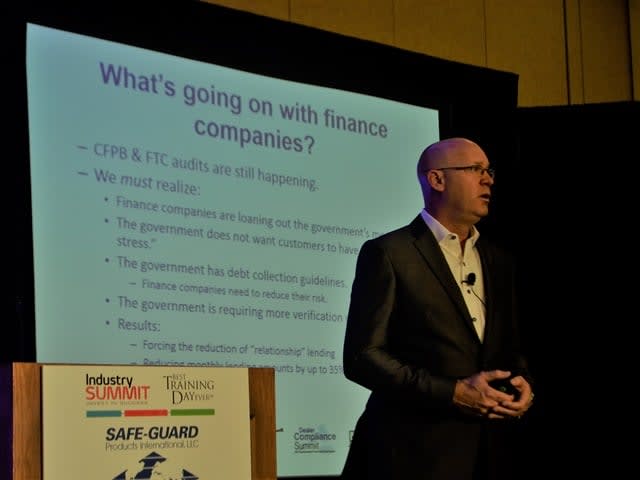
It could be all that. However, The Academy’s Tony Dupaquier offered up another reason at last month’s F&I Think Tank in Dallas. His theory is based on conversations with four primary finance sources, two factory finance companies, and one secondary finance company.
Ad Loading...
"By the way, regulators aren’t fans of lender-to-dealer relationships. They prefer the two sides be at an arm’s length, which means it’s going to get tougher to lean on finance sources to get those tough deals done."
Remember those very public audits and fines the Consumer Financial Protection Bureau (CFPB) was levying against finance sources? Well, they’re still happening; they’re just not being publicized. And according to Tony, regulators are looking beyond a finance source’s entire book of business. They’re auditing individual branches all the way back to the buyers, and they want to make sure finance sources are adhering to the buying guidelines they’re helping to shape.
“The thing we have to realize is the finance companies are loaning the government’s money,” Tony said. “And if they’re loaning out the government’s money, guess who makes the rules?”
What regulators are concerned about is financial stress — not the finance source’s, but the consumer’s financial stress. Also keep in mind the CFPB is in the “proposed rule stage” with its impending debt-collection rules. And all of that is playing into how finance sources operate in the indirect market, which is why they seem to be requiring more stips these days. Not only are they guarding their portfolios, they’re guarding against unwanted attention from regulators.
By the way, regulators aren’t fans of lender-to-dealer relationships. They prefer the two sides be at an arm’s length, which means it’s going to get tougher to lean on finance sources to get those tough deals done.
Ad Loading...
Now, the best thing you can do right now is to get your teams to slow down. Because if there are any issues with the customer’s name, address, phone number, Social Security number, income, VIN, driver’s license, insurance card, odometer reading, or miles on the trade, your deal ends up in “Stipville.”
As business managers, discovering your finance source’s appetite is critical. For a captives, it is new cars first, CPO second. Tony added that finance sources, especially captives, are giving higher loan-to-value limits on certified pre-owned vehicles. For domestics, CPO can add $500 to the LTV; for imports, it’s $1,000. So, certifying your inventory might not be a bad idea.
Now, when working with a customer, consider this question: Is it extravagant or is it good transportation? In other words, trying to stick a credit-challenged customer into an Escalade with 22-inch wheels isn’t going to fly these days. So take note.
In fact, as a vehicle gets more expensive, Tony said, LTV goes down — even if your finance source’s guidelines say it’ll do 120%. “It’s a sliding scale that, frankly, I don’t even think the underwriters and the buyers have full access to. So if I have a heavy negative-equity situation and a lack of cash, maybe we submit it on a less expensive vehicle to increase the LTV to get the deal approved, then flip it to the more expensive unit.”
Captives, like other lending segments, are no longer allowing rebates to suck up negative equity. Additionally, three of the finance sources Tony talked to said their limit for negative equity is $7,500 on prime deals, $3,500 on nonprime. Knowing your finance sources’ negative-equity limit is critical, so get on the horn with them.
Ad Loading...
While you’re at it, find out what their payment-to-income (PTI) limits are. Tony said his sources put it at 15% to 20% for borrowers with a credit score of 640 and above, and between 10% and 15% for nonprime — even as low as sub-10%, in some cases.
Now, the death line for any deal is “130/13,” as in a deal submitted with a 130% advance and a 13% PTI on a customer with a credit score below 640 is dead on arrival.
And if your sales team is having trouble getting a down payment out of customer, train them to say this: “Folks, if you don’t have an initial investment equal to the payment you’re agreeing to, why should a finance company give you a loan?”
Regulators might not like the connection you have with your finance sources, but that doesn’t mean relationships no longer matter. In fact, they’re more critical than ever, especially with everything being such a moving target these days. What it does mean is that those favors you got on those difficult deals might not be available in the near future.
BMW is the latest manufacturer to be accused of falsifying new vehicle sales reports, a practice that has led to lawsuits and investigations. Are dealers conspirators or victims?
The trend toward hybrid sales and finance managers shows no signs of slowing. Dealers who want to close the business office must be sure they don’t shut the door on their customers as well.
Mergers and alliances among factories are proliferating as the demand for mass-market electric vehicles increases and the cost to build them makes profitability impossible.
Noncompliant and outright illegal behavior by dealers, managers, and staff have generated headlines throughout the year. Less heralded are the instances in which dealership personnel took action that led to arrests.
A new-to-market, data-driven solution has reignited the discussion over intentional vehicle overvaluation, a form of bank fraud that remains prevalent despite a string of dealer lawsuits and regulatory actions.
Mounting losses have compelled many underwriters to jump ship on guaranteed asset protection, but it remains a cornerstone product that continues to perform for customers, dealers, and F&I managers.
Fears that F&I would fall victim to advancing technology and bad press appear unfounded as the segment continues to perform for dealers and car buyers.
For all its missteps, Tesla Inc. finally found its footing in 2018, eking out a 1.2% market share and renewing concerns shared by established manufacturers and brick-and-mortar dealers.