





In late October, word leaked that Fiat Chrysler and PSA Group were deeply immersed in merger talks. The Italian-American and French manufacturers may have formed the world’s No. 4 automaker by the time you read this — barring a last-minute reversal, like the one that ended a proposed FCA-Renault merger over the summer.
EVs Cost Even More Than You Think
Mergers and alliances among factories are proliferating as the demand for mass-market electric vehicles increases and the cost to build them makes profitability impossible.
November 14, 2019
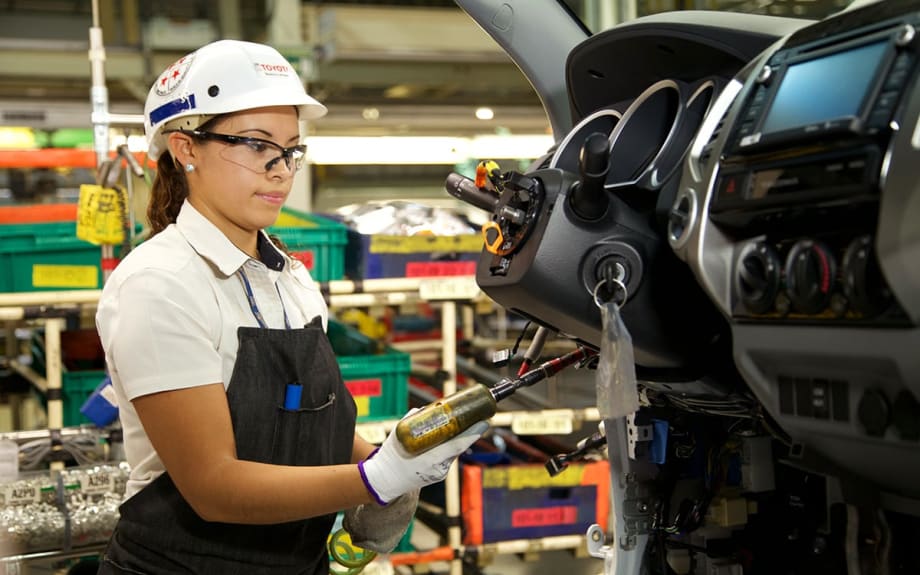
McKinsey analysts say the cost to build a mass-market electric vehicle is about $12,000 higher than its internal-combustion counterpart.
Photo courtesy Toyota Motor Sales USA
3 min to read
In the weeks and months that followed the failed FCA-Renault talks, Ford and Volkswagen finalized a deal to share investments in electric and autonomous vehicle technology, Toyota and BYD, a Chinese manufacturer, agreed to jointly develop electric sedans, SUVs, and batteries, and Tata, the Indian parent of Jaguar Land Rover, issued an all-points bulletin, searching for a partner or partners to help plot a course to the future as global sales slump.
Cooperation among auto manufacturers is not news. The degree of urgency surrounding these deals and proposed deals is. And the most likely cause is electrification.
A recent McKinsey report, “Making Electric Vehicles Profitable,” points out that every EV produced by a mass-market manufacturer represents an additional $12,000 in production costs. The main reason for that is the battery, for which analysts don’t expect prices to normalize for another five to seven years. But there are other costs as well, including the retooling of plants designed to build and assemble vehicles powered by internal-combustion engines.
Depending on the market, only 10% to 30% of Americans are actively considering buying an electric vehicle on their next trip to the dealership.
Factories can’t pass that $12,000 burden on to the consumer — or at least not all of it — and they can’t go on losing money on electric vehicles, because that’s what the world wants.
The latest AAA survey found that, depending on the market, only 10% to 30% of Americans are actively considering buying an electric vehicle on their next trip to the dealership. That’s solid demand, and it’s certainly growing, but not yet overwhelming.
But manufacturers think globally, and similar surveys show much higher demand among European Union nations (up to 60%) and China (up to 70%). If you’re not in the EV business, you’re not in the conversation.
So the factories will continue to build electric vehicles, even at a loss, and they will continue to look for ways to defray that $12,000-per-unit loss. And they have options, as the McKinsey report points out: They can save up to $2,400 per unit by minimizing cabin controls and features, a practice known as “decontenting.” Optimizing battery range for city driving could recoup another $2,100. A proprietary final assembly process would shave off up to $600.
Final assembly optimization leads us to the No. 3 item on McKinsey’s list: partnering with another manufacturer. Sharing research and development costs with a competitor — at least during the transition to an EV-dominant product line — could save both factories $2,000 per electric unit.
That’s a tough number to ignore, and the aforementioned manufacturers clearly haven’t. And as you may have noticed, taking every suggested measure to reduce costs, including a merger or alliance, still leaves the factory holding a $4,900 bag. Cheaper batteries can’t hit the market soon enough.
“Benefits will be especially high if OEMs can share EV platforms and plants, which can still enable multiple model variants,” the McKinsey report states, in part. “These alliances will also be most beneficial when they enable higher-volume procurement of the same battery cells and power electronics to take advantage of scale that is otherwise elusive when going it alone.”
Subscribe to Our Newsletter
More Blog Posts

Is Sales Punching a Crime?
BMW is the latest manufacturer to be accused of falsifying new vehicle sales reports, a practice that has led to lawsuits and investigations. Are dealers conspirators or victims?
Read More →
You Can Eliminate F&I Managers. You Can’t Eliminate F&I.
The trend toward hybrid sales and finance managers shows no signs of slowing. Dealers who want to close the business office must be sure they don’t shut the door on their customers as well.
Read More →
When Dealers Catch Criminals
Noncompliant and outright illegal behavior by dealers, managers, and staff have generated headlines throughout the year. Less heralded are the instances in which dealership personnel took action that led to arrests.
Read More →
A Life of Crime at the Heights of Success
The long list of offenses committed by dealers and other highly successful people proves desperation is not the only cause of criminal behavior.
Read More →
Are We Not Capitalists?
Opponents of franchise laws claim they hang on flawed logic, discourage competition, and benefit dealers to the detriment of consumers.
Read More →
Will Data Put an End to Powerbooking?
A new-to-market, data-driven solution has reignited the discussion over intentional vehicle overvaluation, a form of bank fraud that remains prevalent despite a string of dealer lawsuits and regulatory actions.
Read More →
How to Sell GAP in a Crisis
Mounting losses have compelled many underwriters to jump ship on guaranteed asset protection, but it remains a cornerstone product that continues to perform for customers, dealers, and F&I managers.
Read More →
F&I Is Stronger Than Ever
Fears that F&I would fall victim to advancing technology and bad press appear unfounded as the segment continues to perform for dealers and car buyers.
Read More →
Tesla and the 1% Problem
For all its missteps, Tesla Inc. finally found its footing in 2018, eking out a 1.2% market share and renewing concerns shared by established manufacturers and brick-and-mortar dealers.
Read More →
No Way Is the Way
Rehashing deals at the desk is a losing proposition for the business office, the dealership, and its customers. One expert says dealers and managers must act now or be forced to watch the art of F&I dwindle into obscurity.
Read More →