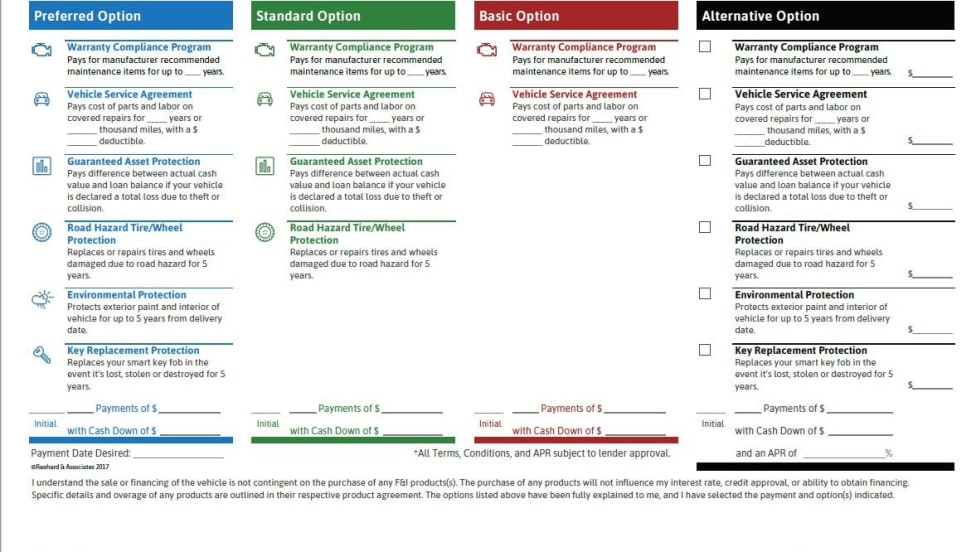
This month’s video question comes from Brandon in Houston, home of the World Series champion Astros. Brandon writes, “So here’s the deal: Some of our vehicles are older and have higher mileage. How do you sell a service contract for $3,000 when the car costs $8,000? The objection from the customer is they’ll take their chances overpaying that extra $3,000.”
Brandon, selling a vehicle service contract on a high-mileage vehicle can be a challenge. The cost of a VSC on these vehicles is proportionally much greater than a service contract on a new car — in this case, almost 38% of the price of the vehicle. Quite frankly, at that price, a lot of people would choose to take their chances.
"You can also use the buyer’s guide from the used car they’re buying to create interest in the service contract. Before having them sign the back of the guide, make sure the customer reads the checked box that states: “A service contract is available at an extra charge on this vehicle. Ask for details as to coverage, deductible, price, and exclusions. If you buy a service contract within 90 days of the time of sale, state law ‘implied warranties’ may give you additional rights.”
Yet, as we all know, buyers of high-mileage vehicles are three times more likely to use a VSC than have a major claim on their medical, dental, or car insurance. We also know that the older the vehicle, and the more miles on the odometer, the more likely a part will fail or something will break.
The key is determining which level of coverage will provide them with a reasonable amount of protection, based on the vehicle they’re buying. That means you may need to see what lower cost plans your other VSC providers offer, or you may need to consider adding a second or third provider that specializes in limited coverage for older, high-mileage vehicles. You may also need to offer a plan with reduced coverage, a shorter term, fewer miles, or a higher deductible.
Unfortunately, you may still be left with a 12-month/12,000-mile service contract that costs $3,000 on that $8,000 used Audi turbo diesel with 170,000 miles. That is going to be a tough sell, but everybody benefits if that customer leaves with at least some level of protection on that used vehicle.
The key is to create some curiosity about the VSC before you attempt to discuss why, in your customer’s case, it might be especially important. Creating interest and then responding to their questions is far more effective than forcing them to listen to a sales pitch.
If the customer declines the service contract after you’ve reviewed his or her options on the menu, you can create interest by making a statement like, “I do find that surprising, especially since you are buying a vehicle built in 2008.” This can lead you right into a discussion about component parts, and the fact that if the vehicle breaks, “we can’t fix it.”
You can also use the buyer’s guide from the used car they’re buying to create interest in the service contract. Before having them sign the back of the guide, make sure the customer reads the checked box that states: “A service contract is available at an extra charge on this vehicle. Ask for details as to coverage, deductible, price, and exclusions. If you buy a service contract within 90 days of the time of sale, state law ‘implied warranties’ may give you additional rights.”
Once they ask about what coverage is available, educate the customer. Make sure you convey the fact you don’t fix anything in your service department anymore. You have component replacement experts. This is also the perfect time to hand the customer an electronic component like a door control module or an anti-lock brake computer and say:
“Every vehicle is now made with component parts. You can’t fix the part that fails. You have to replace the entire component. So, if your gas gauge quits working, you don’t replace the gauge; you replace the instrument cluster. If your fan switch quits working, you don’t replace the fan switch; you replace a climate control module. That’s why repairs on today’s vehicles have become so expensive, because technicians have all become component replacement experts. And a six-speed electronically controlled automatic transmission is going to be expensive to replace.”
The most important part of the F&I sales process is still discovering the customer’s needs before presenting your products. Customer needs are the foundation upon which you have to build the sale of every F&I product. That requires open-ended questions and engaging the customer in a dialogue throughout the F&I process to enable both you and the customer to answer that all-important question: “Why do they need a vehicle service contract?” Until — and unless — you can answer that question, they won’t buy it.
Brandon, thank you for your question. Your YETI is on the way. And don’t forget to submit your own question for a chance to get it answered and receive a free YETI. Because it’s a beautiful day to help a customer, or play ball!
Got a question or objection for Ron? Use your mobile phone to record a brief video (shot landscape style!) of your question and upload it to go-reahard.com/ask-ron.