This month’s question comes via email from a dealer principal in Washington, a beautiful state where you can visit Mount Rainer, follow the Seahawks, and, if you’re so inclined, do the weed. This dealer asks, “It’s getting harder to make money on new cars. We’ve had some turnover with our sales staff, so we’re looking to start paying them on F&I income. Any suggestions?”
Years ago, dealers looked for aggressive, tenacious, money-motivated salespeople. They structured a commission plan designed to motivate and compensate based on volume and profit. While every dealer still wants, needs, and values volume and profit, they also need sales associates to focus on ensuring a great customer experience.
But you still have to move units and make a profit.
"Most dealers do not allow their salespeople to control the gross profit on a sale. That’s the sales manager’s responsibility. However, salespeople can certainly impact front-end gross, so they need to be compensated on it."
Like you, many dealers struggle with salesperson turnover. Most dealers are seeing thinning new-car profit margins, and several manufacturers have reduced or eliminated the incentives salespeople can earn in bonuses. As a result, dealership compensation plans are changing dramatically. Much of that change is fueled by the manufacturers’ desire to make the customer experience a top priority.
Ultimately, a salesperson’s pay plan is their job description. Manufacturers and dealers today are putting more money and resources toward the things that matter most: satisfying customers and growing their share of the business. Pay plans and bonuses are still important, but younger salespeople value consistent compensation and quality of life over working 60 hours a week with the possibility of earning a huge paycheck.
According to the Cox Automotive’s 2017 Dealership Staffing Study, the annual turnover rate among dealership salespeople is 67%. Some dealers are experiencing turnover in their salesforce at a rate of 80% or greater annually. To retain employees, many dealers are offering flexible hours, more time off, and expanded employee benefits. Many have adopted a salary plus commission structure to improve the customer experience and relieve some of the pressure on salespeople to produce.
But you still have to move units and make a profit.
The one bright spot in the dealership profit picture is the F&I department. With the exception of Group 1 Automotive, whose U.S.-based F&I operations still managed a per-copy average above $1,600 despite a $31 year-over-year decline, the five other public dealer groups reported increases in F&I profit per vehicle retailed in the second quarter. The average ranged from a low of $1,247 at Penske to $1,789 at AutoNation — an all-time record for the group. And with new-car grosses under attack, sales managers, salespeople, and everybody else on your payroll wants a piece of the F&I pie.
A salesperson’s pay plan should compensate them based upon their productivity. No matter how big or small your dealership, a salesperson’s commission should increase or decrease according to performance. The two primary areas salespeople have virtually total control over, and on which the majority of their commission should be based, include:
Units sold: To be a salesperson, you first got to sell something.
Customer satisfaction: Hey, customers won’t be back if it’s not a good experience — costing you many more potential sales.
While secondary to units sold and customer satisfaction, the following areas are also vitally important to dealership profitability. Salespeople, to a lesser extent, impact all of them. Most dealers do not allow their salespeople to control the gross profit on a sale. That’s the sales manager’s responsibility. However, salespeople can certainly impact front-end gross, so they need to be compensated on it.
Front-end gross: It doesn’t matter how many units you sell if the dealership isn’t making any money on them.
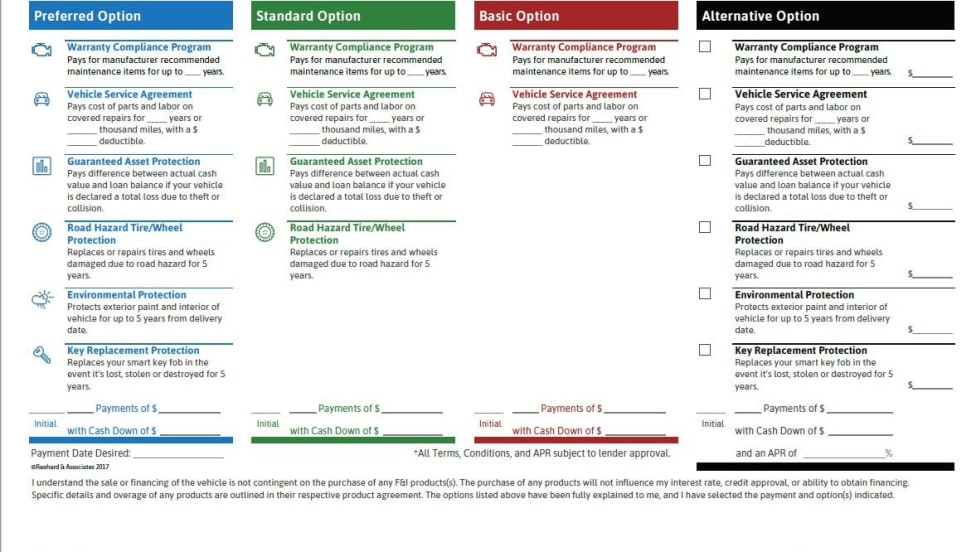
F&I products per vehicle retailed: In most dealerships, salespeople are not responsible for selling F&I products. But they can have a huge impact on the F&I department’s ability to do so.
Ongoing training: If you want training to be important, it has to be part of your sales team’s job description, a.k.a. their pay plan.
Online reviews: If you want reviews on Google, Facebook, and Yelp, they have to be part of your sale team’s pay plan.
Obviously, the percentages you pay have to be based upon your dealership and your expected performance levels. Hopefully, this will help as you formulate your new pay plan, because one thing about being a successful dealer will never change: You still have to move units and make a profit.
If you have a question you would like answered or an objection you need help with, send it to me. You’ll get it answered and receive a free YETI. Because it’s a beautiful day to help a customer, or another F&I professional.
Got a question or objection for Ron? Use your mobile phone to record a brief video (shot landscape style!) of your question and upload it to go-reahard.com/ask-ron.