This month’s video question comes from Mike in Caldwell, Texas, home of the Hornets and one big, beautiful water tower. Mike asks, “I offer six to eight products on my menu, and I believe in every one of them. How do I keep my customer focused and not confused?”
Mike, I’m glad to hear you believe in your products. It’s always easier to sell them when you do. And regardless of how many products your dealership offers, an F&I professional has a responsibility to review every customer’s repayment, risk management, and vehicle protection options so they can make an informed decision about the options available in connection with their purchase.
"Unfortunately, when you’re reviewing eight different products on a menu, it’s likely a customer’s attention will wander. At some point, he or she will lose interest — no matter how important you feel those products are. That’s why dealerships with high F&I income and products per retail unit typically offer no more than five or six F&I products. After that, it becomes more than the customer can absorb."
That’s one of the biggest advantages of using a menu. It allows us to do that in a minimum amount of time, and it takes the pressure out of the process. Now, a customer who wants two or three products may very well select an option package that includes four or five. However, a customer is not going to buy 10 products when he or she only want one or two.
Unfortunately, when you’re reviewing eight different products on a menu, it’s likely a customer’s attention will wander. At some point, he or she will lose interest — no matter how important you feel those products are. That’s why dealerships with high F&I income and products per retail unit typically offer no more than five or six F&I products. After that, it becomes more than the customer can absorb.
To present every product without losing the customer, the first thing you need to do is put some of those products into packages. For example, combine tire-and-wheel protection, windshield chip repair, paintless dent repair, and key replacement into an “Ultimate Care” or “Multi-Care” protection package. This immediately reduces the number of products the customer has to consider. Yes, those products may still require separate agreements that have to be completed and signed, but it’s far fewer options the customer has to consider.
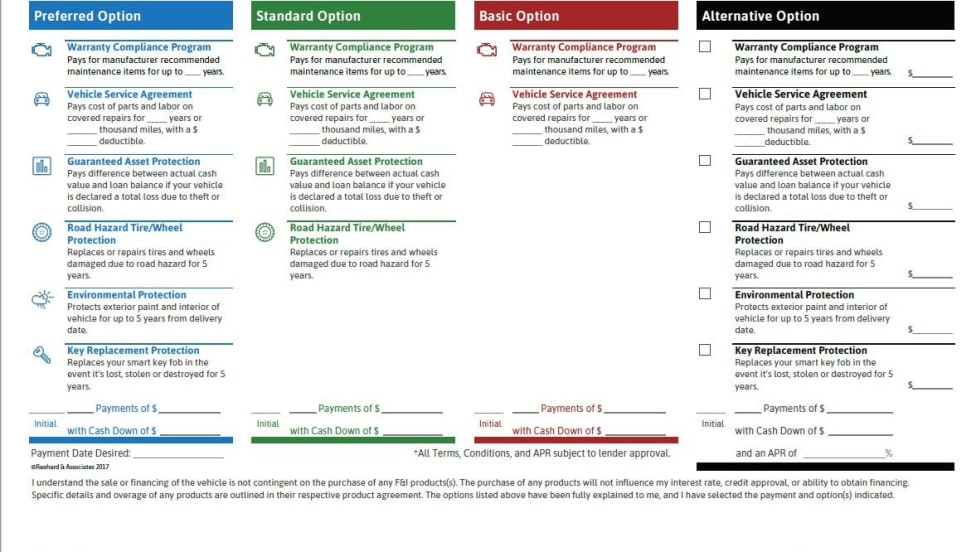
Remember, a menu should be used to quickly review with the customer all the options available. It’s not a product brochure. And a proper introduction and explanation are critical. “Bob, before we finish up the paperwork, I need to go through this disclosure form with you. I’m required to review your repayment, risk management, and vehicle protection options, and answer any questions you may have. Would that be OK with you?”
Next, eliminate customer fear by disclosing the payment they agreed to prior to reviewing or discussing any options. They need to be reassured the payment they were given is correct, and that they can take delivery of the vehicle for that amount. And while that payment is correct, they do have several options available in connection with their purchase.
Now, there should be no selling of any product the first time through the menu. Simply explain what each product is and does. When customers don’t get the sales presentation they were expecting, they start asking questions and will volunteer reasons as to why they don’t think they need a particular product. This opens up a dialogue about the product, allowing you to focus on what is important to the customer and why — in his or her particular situation — this product might be especially important.
After presenting the customer’s options, it’s critical your customer feels he or she is in control. You cannot go down the list and sell whatever product you make the most money on, followed by your next most profitable product, and so forth. You must follow the customer’s lead by first discussing those products he or she is most interested in knowing more about. In other words, if the customer wants to know what environmental protection is, that’s what you explain first.
One thing I know for a fact is eight product presentations will never be as effective (or as profitable) as an enthusiastic, needs-based conversation about two or three products. Mike, success in the F&I office comes down to your passionate belief in your products, your absolute conviction that this customer needs this particular product, and a sincere desire to help every customer see how each product will benefit them specifically. To keep customers engaged, your focus must be on answering one question; “How will this product help them?”
Mike, thanks for your question. Your YETI is on the way. And don’t forget to submit your own question for a chance to get it answered and receive a free YETI. Because it’s also a beautiful day to help a customer — or leave your mark in Caldwell, Texas.
Got a question or objection for Ron? Email it or use your cellphone to record a brief video (shot landscape style!) of your question and upload it to go-reahard.com/ask-ron/.