This month’s video question comes from Tommy in Atlanta, home of the Fox Theatre, an elaborate and intensely ornate theater with soaring domes, minarets, and sweeping archways. King Tut himself would feel right at home in this place.
“Here’s the deal,” Tommy says. “I had a cash customer. I went over the menu with them and they purchased a vehicle service contract only. I had them initial and sign for it. I then attempted to sell them other products. That’s when the customer said, ‘You know what? Just forget it. I don’t want anything.’ I lost the sale. My question is, when you have only sold one product, should you try to sell something else and jeopardize losing what you have in the bank? What say you, Ron, because it’s a beautiful day to help a finance manager?”
"The difference with cash buyers is they are not concerned about the payment or whether the package will fit into their budget. In their mind, they have agreed to purchase this one additional product — in this case, the service contract — and nothing else. They’re already buying an additional product they weren’t planning to buy and spending additional money they weren’t planning to spend."
Tommy, I know every F&I manager out there feels your pain, because what happened to you has happened to every producer at some point. You sell one product, then end up losing it when you try to sell additional products. Yeah, that really hurts.
The customer changed his or her mind because he or she had not yet taken mental ownership of the service contract. Unfortunately, that can occur with finance customers as well as cash customers. We’ve all had to resell our products to a finance customer who purchased them based on the change in their payment. Then, when they see the cash price of a particular product on the product agreement or retail installment sale contract, they suddenly have second thoughts.
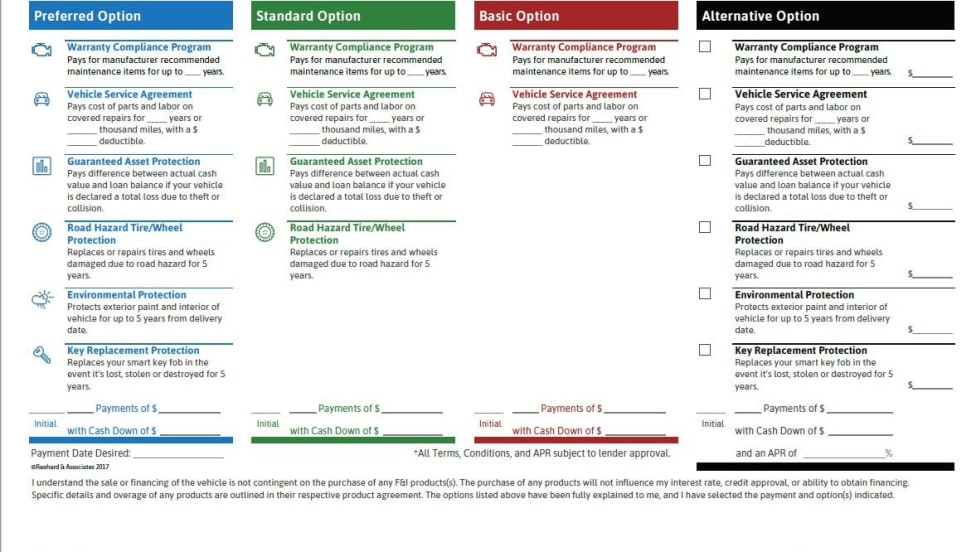
With a menu, what we’re trying to do is first sell one product, the one the customer is interested in or the one he or she needs the most. Once the customer decides to purchase that first product, we then ask him or her to buy a package. Unfortunately, you can only “sell” two or possibly three products. After that, the customer’s “I’m being sold” alarm goes off. Yet, a customer can and will “buy” six or seven products packaged together simply because we asked them to.
With a finance customer, if he or she declines to buy the package or indicates he or she only wants the service contract, the transition statement we use is, “OK, so you want the service contract. You’re just not sure about the others? Let me see what the payment will be with just the service contract.” We then attempt to create interest in another product that may be important to the customer and his or her family, based on his or her situation.
The difference with cash buyers is they are not concerned about the payment or whether the package will fit into their budget. In their mind, they have agreed to purchase this one additional product — in this case, the service contract — and nothing else. They’re already buying an additional product they weren’t planning to buy and spending additional money they weren’t planning to spend.
So, when a cash buyer declines to purchase the package on the menu, by all means, print out the service contract agreement and have the customer sign it. Once he or she signs it and you hand over a copy, the customer has now taken mental ownership of it.
Unfortunately, your customer had not yet taken mental ownership of the service contract, even though he or she verbally agreed to buy it and initialed and signed the menu. Once the customer signs the actual service contract application or agreement, and you put his or her copy with the other deal paperwork, the customer almost always takes mental ownership. Then, and only then, can you go back and talk to them about a second product. The key is you attempt to sell only a second product, not a package. Otherwise, a cash buyer feels like now you’re trying to sell him or her a bunch of additional products he or she has no interest in. It’s also imperative that your discussion of the second product be based on the customer’s needs, and why, in his or her case, that product might be especially important.
Tommy, thanks for your question. Your YETI is on the way. Don’t forget to submit your own question for a chance to get it answered and receive a free YETI. Because like Tommy said, it’s also a beautiful day to help an F&I manager!
Got a question or objection for Ron? Use your mobile phone to record a brief video (shot landscape style!) of your question and upload it to go-reahard.com/ask-ron.