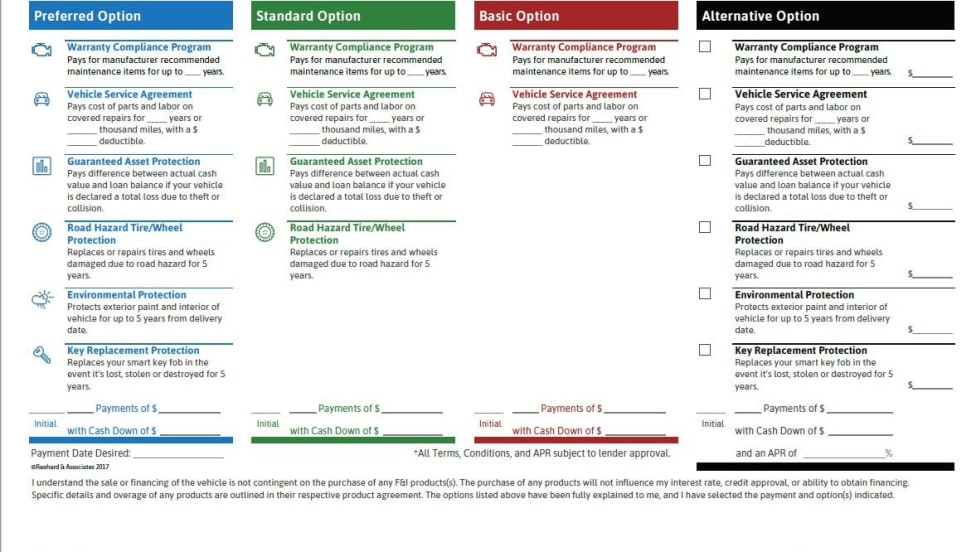
This month’s video question comes from Steve in St. Louis, home of the City Museum — an interactive theme park where, for only $12, anyone can be a kid again. Steve says, “Maintenance is a really popular product at our dealership. But lately, we’ve had some customers that want to save some money by doing the maintenance themselves. How would you handle this objection?”
Everyone knows that one of the best ways to avoid expensive repair costs is to properly maintain your vehicle. For most manufacturers, required maintenance items specified in the owner’s manual are performed at the owner’s expense. A few manufacturers include all the recommended maintenance on their vehicles for a limited time. It’s usually one of their major selling points.
"Just using the term “warranty compliance program” to describe a maintenance plan will dramatically increase customer interest in the product, since the failure of or damage to vehicle components due to lack of required maintenance is typically not covered by the manufacturer’s limited warranty."
Most complimentary maintenance plans include an oil and filter change at predetermined intervals, lubrication of key chassis parts, and tire rotation. Most plans also include a comprehensive, multipoint inspection that includes checking tire pressure, tire wear and various fluid levels, as well as visually inspecting specific items that are prone to deterioration and wear and tear.
Unfortunately, most people don’t like to prepay for anything, but they do want to make sure they comply with the manufacturer’s maintenance requirements. Just using the term “warranty compliance program” to describe a maintenance plan will dramatically increase customer interest in the product, since the failure of or damage to vehicle components due to lack of required maintenance is typically not covered by the manufacturer’s limited warranty.
By grouping all manufacturer-recommended maintenance into a comprehensive program, a warranty compliance plan can offer significant savings over purchasing those services individually. In fact, the total cost over two, three or four years may actually be less than what a customer would pay at Scruffy Lube just for oil changes.
A warranty compliance program helps ensure all the maintenance requirements needed to keep the factory warranty in effect are performed when they are required to be performed. It also provides documentation that it was done. Keep in mind that maintenance requirements are no longer limited to oil changes.
See, with today’s longer service intervals, most manufacturers include required inspections as part of their maintenance requirements. These multipoint inspections must be done by a trained technician. If problems arise because these inspections weren’t done, the manufacturer may refuse to cover the repair on grounds that the recommended maintenance was not done.
Plus, each time a vehicle’s VIN is entered into a dealership’s computer system, it automatically checks to determine if there are any service bulletins or recall repairs that need to be completed on the vehicle. This is one of the most important reasons to have your maintenance performed at the dealership.
Having a detailed service history on your vehicle showing that all your maintenance was performed at the dealership when it was required to be performed can dramatically increase its resale value. Plus, when you have your vehicle serviced at the dealership, it shows up on the Carfax report. Having the ability to produce documentation of all the work that has ever been done on the vehicle — and prove it has always been properly maintained according to the manufacturer’s specifications — will ensure your customers get the maximum return on their investment. So, if a customer says he wants to save money by doing the maintenance himself, you might say something like:
F&I manager: I can certainly understand why you would want to do that. You certainly don’t want to spend any more on maintenance than necessary, right?
Customer: Right.
F&I manager: However, with today’s longer service intervals, there is a lot more to maintaining a vehicle than just changing the oil. This is actually a warranty compliance program that includes a multipoint inspection recommended by the manufacturer and performed by a trained technician. Plus, at each service interval, all fluid levels are inspected and replenished, per the manufacturer’s specifications, using only factory-authorized parts and fluids. More importantly, every time your vehicle’s identification number is entered into our dealership’s computer system, it automatically checks for service bulletins, software updates and recall repairs that need to be performed on your vehicle, reducing the number of trips to the service department. And you don’t want to spend any more time or money maintaining your vehicle than you have to, right?”
Customer: “That’s true.”
Steve, thank you for your question. Your YETI is on the way. Don’t forget to submit your own question for a chance to get it answered and receive a free YETI. Because it’s a beautiful day to help a customer!
Got a question or objection for Ron? Use your mobile phone to record a brief video (shot landscape style!) of your question and upload it to go-reahard.com/ask-ron.