WASHINGTON, D.C. — At F&I Think Tank 2017, held in Dallas on Sept. 14, F&I trainer Tony Dupaquier of The Academy revealed that the Consumer Financial Protection Bureau (CFPB) was actively monitoring the auto finance industry, performing audits to ensure finance sources are adhering to buying guidelines it’s helping to shape.
The revelation was based on interviews with representatives from four primary finance sources, two factory finance companies, and one secondary finance company. And according to those conversations, Dupaquier shared, what the regulator is concerned about is financial stress of the consumer.
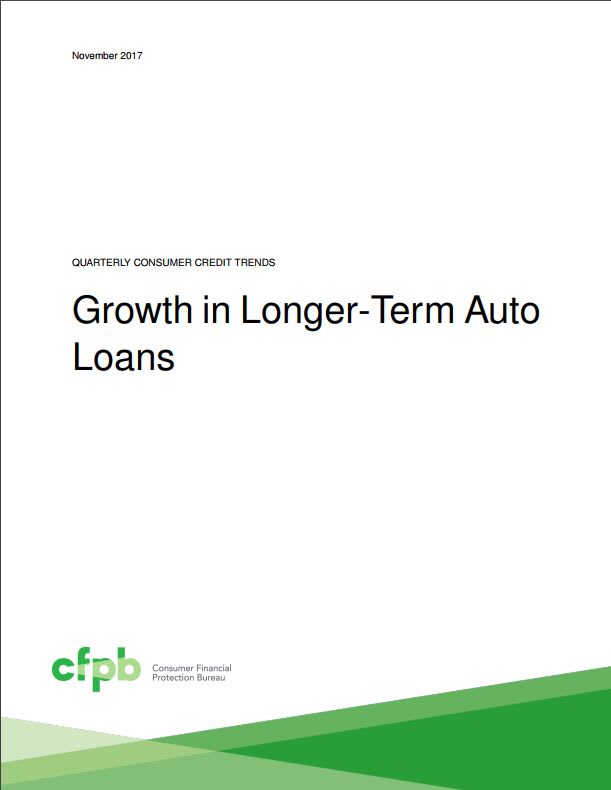
On Tuesday, the CFPB released “Growth in Longer-Term Auto Loans,” and eight-page report that seemed to back the claims of Dupaquier’s anonymous sources. The bureau, however, noted that the report is part of a series of quarter reports of consumer credit trends using a “longitudinal, nationally-representative sample of approximately five million de-identified credit records from one of the three nationwide credit reporting agencies.”
The report centered on loan terms, noting that 42% of auto loans made in the last year carried a payback term of six or more years, compared to 26% in 2009. It also warned that six-year auto loans are riskier, cost more, are often used by consumers with lower credit scores to finance large amounts, and have higher rates of default.
“The move to longer-term auto loans is opening up more risk for consumers,” said CFPB Director Richard Cordray. “These loans are more expensive and can result in consumers continuing to owe even after they are no longer driving their car. Consumers should know before they owe and shop for the best deal based on costs incurred over the life of the loan.”
The report does concede that consumers are simply financing larger amounts, and are electing for longer terms to keep monthly payments affordable. The regulator, however, notes that the availability of longer-term loans may be the reason car buyers are financing more.
According to the bureau’s report, the average original loan amount for a five-year loan was $20,100, compared to $25,300 for a six-year loan. The average finance amount for loans with terms of seven years or more was $32,200. “To the extent that consumers are buying more expensive cars, making smaller down payments, or otherwise financing larger loan amounts, the increased use of these longer-term loans may be a result,” the report states.
The bureau notes in its report that the average amount financed in 2009 was $18,179. By 2016, the average increased by 16%. And because of longer-term loans, the average monthly payment increased only 7% over that same period. However, the report also shows that loans with terms of six years or more had a default rate that exceeded 8%, whereas shorter-term loans have had default rates closer to 4%.
“That means that six-year loans are about twice as likely as five year-loans to result in a default,” the report states, in part. “The greater adoption of these loans may potentially pose greater risks to both consumers and lenders.”
The reason, according to the bureau, is consumers with lower credit scores are typically the ones electing for longer-term loans. The report notes that the average credit score for borrowers who take out six-year loans is 674, which is 39 points below the average for borrowers who take out five-year loans.
“The higher default rates observed for six-year loans should not be interpreted as a causal relationship,” the bureau warns. “Borrowers who expect to struggle making the payments on a loan financed over five years may be more likely to opt for longer-term financing to ease their financial burden each month. Riskier borrowers may thus prefer longer-term loans, which is consistent with our [findings] that borrowers taking out six-year loans tend to have lower credit scores than borrowers with five-year loans.”