FI showroom red and grey logo
MenuMENU
SearchSEARCH

CFPB: 20% of Single-Payment Auto Title Loans End in Repossession

A report form the CFPB found that about 20% of auto title loan borrowers end up having their car or truck seized by the lender for failing to repay their debt. Eighty percent fall into a debt trap, with more than 66% having to take out seven or more consecutive loans to fully repay their debt.

by Staff
May 18, 2016
2 min to read


WASHINGTON, D.C. — A report released today by the Consumer Financial Protection Bureau (CFPB) analyzed the dangers that auto title loans pose to consumers. By examining nearly 3.5 million anonymized, single-payment auto title loan records, the agency found that about 20% of borrowers who take out a single-payment auto title loan end up having their car or truck seized by the lender for failing to repay their debt.

More than 80% of single-payment auto title loan borrowers also wind up renewing their loan the day it’s due because of being unable to pay, according to the report. This, the report adds, has the consequence of more than 66% of borrowers having to take out seven or more consecutive loans until they’re able to fully repay.

Ad Loading...

“Our study delivers clear evidence of the dangers auto title loans pose for consumers,” said CFPB Director Richard Cordray. “Instead of repaying their loan with a single payment when it is due, most borrowers wind up mired in debt for most of the year. The collateral damage can be especially severe for borrowers who have their car or truck seized, costing them ready access to their job or the doctor’s office.”

The average amount for an auto title loan is $700, according to the CFPB. The typical annual percentage rate for a loan is about 300%. The report examined single-payment auto title loans, where a borrower is required to repay the loan in a lump sump that includes the loan amount, interest and fees. Twenty states in the U.S. allow for this form of loan, however, five states only allow for title loans that can be repayed in installments. 

Borrowers generally use these title loans to cover an emergency or other cash-flow shortage between paychecks or other income, according to the CFPB. Borrowers use their vehicle for collateral and the lender holds their title in exchange for a loan amount. If the loan is repaid, the title is returned.

While examining auto title loans, the CFPB found that borrowers of title loans shared many of the same issues that borrowers of payday loans have. Along with high interest rates, both types of loans lead to high rates of consumer reborrowing, which can create long-term debt traps.

For more, click here.

More F&I

F&Iby Lauren LawrenceFebruary 25, 2026

Report Finds Year-End F&I Strength

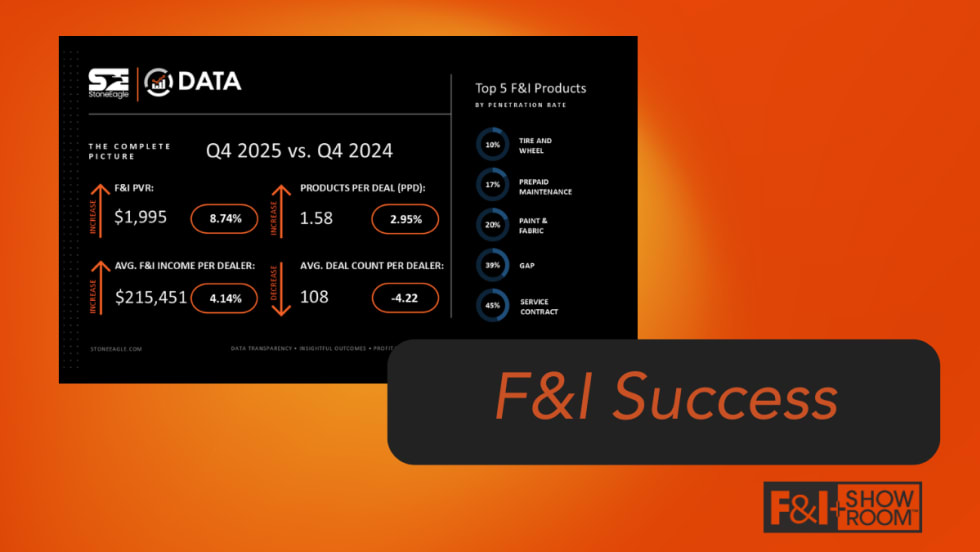
Deal volume ebbed and flowed throughout 2025, but product performance remained steady, according to automotive technology and data intelligence solutions provider StoneEagle.

Read More →
F&Iby Hannah MitchellFebruary 23, 2026

Some Auto Brands Cheaper to Insure

A new top 10 list ranks the least expensive for average full insurance coverage on a clean driving record and high driver credit scores.

Read More →
F&IFebruary 13, 2026

Business Office Blueprint

Try following these 20 steps to greater success in the dealer F&I office this year.

Read More →
Ad Loading...
Industryby Lauren LawrenceFebruary 11, 2026

Insurance Shopping on the Rise

A TransUnion study found that relationship-driven sales models proved to be important, as consumers who used an agent had a lower shopping intensity than those going it alone.

Read More →
Industryby Hannah MitchellFebruary 4, 2026

Auto Insurance Cost Reprieve

2025 brought consumers relief after years of rate hikes, but 2026 could bring renewed policy pain, depending on how U.S. trade policy affects prices.

Read More →
Reese Dailey from Automotive Training Academy by Assurant
F&IFebruary 4, 2026

Cash Deal Strategies

In this video, Reese Dailey of the Automotive Training Academy by Assurant reveals strategies to make cash deals profitable without relying on monthly payment bumps.

Read More →
Ad Loading...
Cox Automotive and Dealertrack logos displayed over a dealership showroom background.
F&Iby StaffFebruary 3, 2026

Cox Auto Says Dealertrack Offers Greater Finance Efficiency

Suite of new APIs, product enhancements and integrations is designed to help maximize contracting and funding efficiency for lenders and their dealer partners.

Read More →
F&Iby Hannah MitchellJanuary 12, 2026

Auto Credit Access Loosens

December brought some of the best borrowing availability for consumers in years, though lenders tightened their reins on riskier segments of the market.

Read More →
F&IJanuary 7, 2026

Resistance to the Menu

In this video, Reese Dailey of the Automotive Training Academy by Assurant explains how to handle a customer who isn’t willing to listen to your pitch.

Read More →
Ad Loading...
two-vehicle rear-end collision
F&Iby Lauren LawrenceJanuary 7, 2026

EV Collision Claims Spike

Third-quarter battery electric vehicle insurance claims were up 4% year-over-year. A new report says EV claims cost the most due to complex technology and limited after-market parts supply.

Read More →