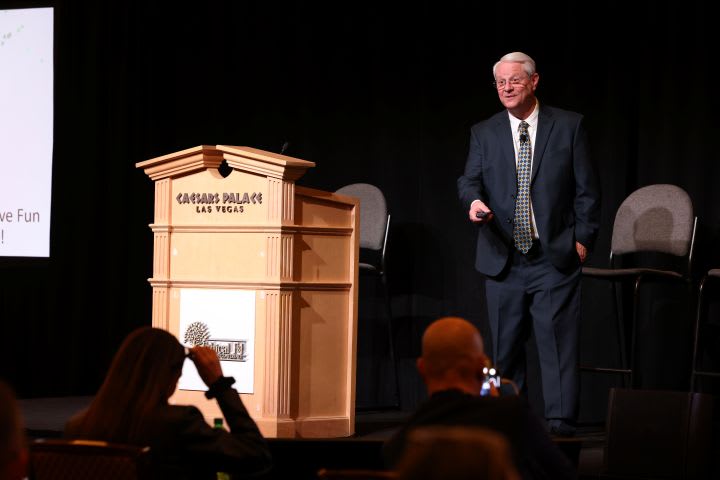
Training veteran Rick McCormick demonstrates how to help customers have a good experience and leave your office with products for their vehicles.
Like a good salesman – and he used to sell F&I products – training expert Rick McCormick knows the value of a good prompt.
At this year’s Ethical F&I Managers Conference, he pulled out several of his current go-tos as illustrations of his keynote speech points. They included a yellow neon check-engine light.
“I have these in F&I offices all over the country,” he told his audience, flipping the light’s switch.
“Just sit here and turn it off and on, and the customer laughs. And you know what the F&I manager does next here? ‘Let me show you what it’s going to cost you.’ He puts a repair order in front of them, because when they laugh, the stress goes out.”
The light-hearted prompt, akin to a toy a photographer keeps on hand to break the ice with child portrait subjects, can have the same effect for adult consumers, McCormick showed.
Fun Times
Having fun in the F&I office was the main point he drove home for his listeners. Such a seemingly simple strategy, far from being an afterthought, happens to be an essential element conspicuously missing in most F&I offices across the country. And McCormick should know – he visits quite a few on his training travels.
He cited a Cox Automotive statistic that 40% of car buyers feel stressed during the purchase process.
The check-engine light is one of his frequent cases in point when he conducts trainings. And when he convinces an F&I manager with flagging sales to add one to his presentation, McCormick said that manager’s service contract penetration jumps 15%.
“Just like that, overnight,” he said. “You know why? They're having fun. That's what customers want.”
Within the process of breaking down the customer’s guard through fun lies the essential elements of personal connection and emotion, McCormick emphasized.
Since everyone wants to be known and appreciated, it’s important that F&I managers make each customer’s visit personal. For one thing, fun elements like the check-engine light can emotionally connect a customer to a product, McCormick said.
“Connecting is more powerful than closing every time,” he said. “Don't give me the best closer, give me the best connector, because when you have fun, it will connect, but if you sell something, it'll separate you.”
Risky Business
Of course the whole reason car buyers stop in the F&I office is for the protection of themselves and their new vehicles. So though the fun factor helps them relax into that part of the process, their instinct for risk aversion should also make it a productive stop on their dealership visit.
Since a vehicle is easily one of the costliest purchases most people ever make, most are keen to minimize the lifetime cost of their automobiles. That motivation is all the more relevant today due to continuously increasing parts and repair costs, McCormick pointed out. He shared a CNBC-reported statistic the nearly 20% car repair cost inflation over the past year surpassing overall inflation.
To assuage customers’ anxiety about getting stuck with expensive maintenance over time, it’s important that F&I managers demonstrate strong knowledge of the products they present to customers and an unwavering belief that the price of protection is lower than the cost of repairs, McCormick said.
Though consumers do want to enjoy the experience of buying a car rather than dreading it, they also want to have confidence in the professionals they work with at the dealership, he said, explaining that F&I managers’ knowledge goes a long way in building trust and therefore sales.
“So if you want to raise numbers, if you want to see penetration go up, if you want to see overall dollar-per-car go up, it's product knowledge that does it.”
That means F&I managers should work to stay abreast of industry developments and know the products they sell like a mechanic knows the way around an engine.
“When the words of the F&I manager make sense, it shows forethought, depth of understanding, and it will drive acceptance levels to record levels,” McCormick said. “So if you minimize risk, you influence the single largest motivation in every customer's process.”
Proof Positive
Once the customer’s natural defenses come down through lighthearted fun and see that products can unburden them from the risk of maintaining their new vehicles, the finance manager must present one more thing for the person on the other side of the desk to commit: proof.
That is, consumers have to be convinced that a product is something they actually need, McCormick said.
“… selling a tangible product requires creating a desire. Selling an intangible product requires discovering a need. This is the one thing that's never changed. Selling products has always been about discovering a need and then showing the solution to fill that need.”
That enduring reality means that F&I managers much work to discover each customer’s needs instead of throwing their entire product line at everybody who walks in their offices.
“It's not just important that you see it,” McCormick said of a product need. “They have to see it.”
Many F&I managers, though, tend to focus on the dealership’s various products and how to sell them to the nameless masses who visit their stores each year, he said.
“But we're into selling, selling, selling, closing, closing, closing, and we don't even know why they need it, because we haven't talked to them.”
Remember, McCormick said as he ended his talk, “Have fun in F&I” because that’s what works best for the customer.
“Really, oh, yeah, it's the funnest job you'll ever have in your life.”
Hannah Mitchell is executive editor of F&I and Showroom. A former daily newspaper journalist, she honed her craft covering politics, business and more for publications that included the Charlotte Observer and the Orange County (Calif.) Business Journal. She holds a master’s degree in journalism from Columbia University, and her first car was a hand-me-down Chevrolet Nova.