Be sure you know the three F&I ‘gotchas’ that compliance auditors, regulators, and plaintiffs’ attorneys will be hunting for in 2020 with this three-minute read.
by Ryan Daly
January 27, 2020
Dealers and F&I professionals would be wise to avoid common practices that run afoul of state and federal laws.
Photo by Abby_Normal via Getty Images
5 min to read
Gotcha! It’s fun to say, not so fun to hear — particularly when you’re hearing it from the Federal Trade Commission, Consumer Financial Protection Bureau, or any other regulatory authority. And those regulators are looking for reasons to say it.
If you don’t have the proper training and procedures in place in your F&I department, your dealership is open to threats such as fines, jail time, expensive lawsuits, reputational damage, and even the closure of your business.
When your dealership acts as a bank, as in the case of the sale of a car, there are many regulations and requirements that must be followed. Also, all the forms, disclaimers, and signatures are dependent on the specific deal. Some of the laws include the Truth in Lending Act, OFAC, and Red Flag regulations.
Below are the three most common F&I gotchas and how to avoid them. For some, this is a review; for others, it’s new information. Whatever your level of experience, it won’t hurt to take a look.
Gotcha No. 1: The Deal Jacket
All dealerships that extend credits must follow the federal Truth in Lending Act as outlined in Regulation Z. TILA protects customers in their interactions with lenders, including car dealers by requiring full disclosure of the cost of credit, the term of the loan, the total amount of the loan, interest rate, and so on. Penalties for noncompliance range from a couple thousand up to millions of dollars.
Ad Loading...
Whether your next audit is conducted by a dealer consultant or as part of an investigation or lawsuit, assume analysts will be looking for:
• False credit applications: There are numerous regulations and requirements dealers must follow in a deal jacket. Changing credit applications or not adhering to the Fair Lending Act isn’t acceptable, it’s vital that all your information is accurate. You would not believe how many dealers have violated this one by marking the rate up on non-English-speaking customers.
The rules make it very clear that you can’t do this.
• Payment packing: The FTC has strong guidelines to make sure you’re not inflating customer payments with fraudulent figures. I’ve seen some dealers intentionally give the wrong information to the customer to manipulate the payment to sell a product and make more money. The rules make it very clear that you can’t do this.
• Red Flags violations: Too many dealerships overlook OFAC and Red Flag policies. OFAC aids in identifying terrorists and money launderers, with fines that range into the millions. Red Flags was designed to identify people who have stolen identities. I’ve seen dealers bypass this rule simply to sell a vehicle.
Ad Loading...
Noncompliance and its associated costs are never worth the sale. In one dealership group, for instance, I uncovered a major payment packing situation. Once the issue came to light, the general sales manager and finance director who were in on it were let go. This has resulted in lower sales due to management turnover as well as a bad reputation in the community they serve.
Gotcha No. 2: Inventory Liabilities
If an FTC auditor walked your lot, would they find these federally mandated documents on every unit?
• Buyer’s guide: Using the most recent buyer’s guide is the simplest way to ensure you have the right information on your used vehicles. I’ve seen several dealers who do things their own way and use the old buyer’s guide simply because they didn’t understand the new one. That’s still a violation.
• Monroney sticker: This gotcha is an oldie but a goodie. Around since 1958, it requires you to display lots of information, including the cash trust rating, gas mileage, and the price. It might seem appealing to hide this sticker in order to increase the price of your vehicles, but it’s easy to forget you could see jail time if it’s not displayed on the vehicle.
Ad Loading...
A messy F&I office is a sure sign of prosperity and a reliable source of unsecured personal data.
Photo by Casanowe via Getty Images
Gotcha No. 3: Unsecured Customer Information
The Gramm-Leach-Bliley Act requires dealerships to safeguard customer information in secure locations. Even if you think you’re being safe and secure with your customer information, make sure you’re properly disposing of information with shredders and securing information using locked drawers and cabinets. Leaving private information out on your desk isn’t OK either.
These three gotchas are just some of the most common ways we’ve seen dealerships make big mistakes when it comes to deal jacket transactions. The No. 1 excuse for these costly errors is related to a fourth gotcha: when an employee says “I didn’t know.”
An untrained employee is your biggest area of risk.
Make sure you know the laws and regulations that govern you, and then be darn sure that every member of the F&I team knows them too — even if it’s their first day on the job.
Ad Loading...
An untrained employee is your biggest area of risk. It’s a tough thing to accomplish in a market where turnover can be high, but if you want to avoid making mistakes that attract regulatory penalties, your employees need to be trained.
Training compliance starts at the top — make sure GSMs and other managers have completed required trainings, and that they talk about it with their groups. Knowing that it’s important enough for the boss to take the training makes a big impact on getting the rest of the team to get it done.
A gotcha from a regulatory authority can be a costly and painful one, but with the right information and training, it can be avoided.
Ryan Daly is district manager for KPA F&I East Central and an experienced sales and finance compliance consultant.
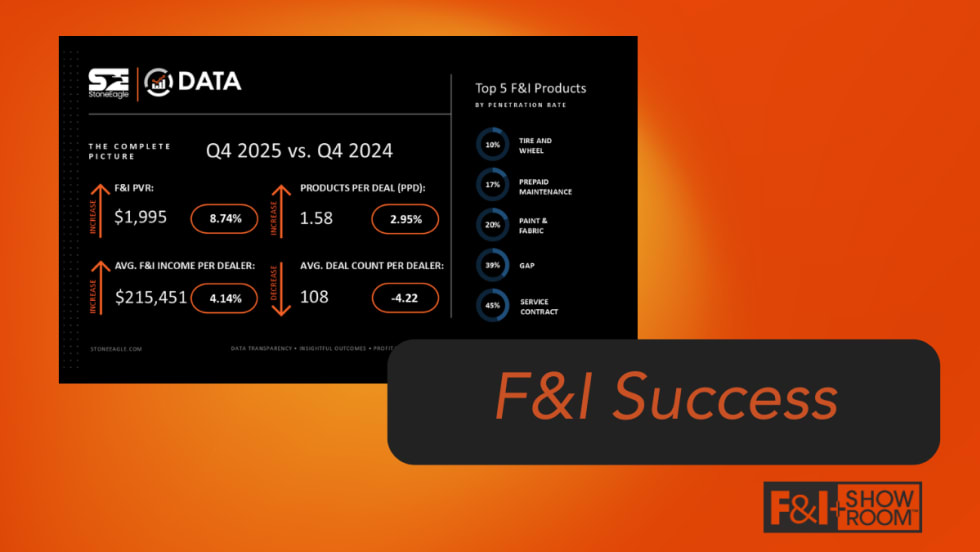
Deal volume ebbed and flowed throughout 2025, but product performance remained steady, according to automotive technology and data intelligence solutions provider StoneEagle.
A TransUnion study found that relationship-driven sales models proved to be important, as consumers who used an agent had a lower shopping intensity than those going it alone.
In this video, Reese Dailey of the Automotive Training Academy by Assurant reveals strategies to make cash deals profitable without relying on monthly payment bumps.
Suite of new APIs, product enhancements and integrations is designed to help maximize contracting and funding efficiency for lenders and their dealer partners.
December brought some of the best borrowing availability for consumers in years, though lenders tightened their reins on riskier segments of the market.
In this video, Reese Dailey of the Automotive Training Academy by Assurant explains how to handle a customer who isn’t willing to listen to your pitch.
Third-quarter battery electric vehicle insurance claims were up 4% year-over-year. A new report says EV claims cost the most due to complex technology and limited after-market parts supply.