A new report from Morgan Stanley identifies several key factors that could cut used-car values in half by 2022.
by Staff
April 10, 2017
2 min to read
An alarming new report from Morgan Stanley warns a combination of factors could drive used-car values down by up to 50% in the next four to five years. Photo by Zelda Richardson
NEW YORK — A new report from Morgan Stanley warns that used-car values could fall by 25% to 50% in the next four to five years. It was prepared by a team of researchers led by Adam Jonas, a CFA and equity analyst for the firm.
“Anatomy of a Used Car Downturn (in Charts)” examines key factors affecting used-vehicle pricing, including a growing supply of off-lease units, stretching credit terms, and the growing representation of subprime credit customers in auto finance portfolios. Rising interest rates, spurred by a series of Federal Reserve-ordered hikes, could combine with a high number of negative-equity trade-ins to restrict the availability of credit to used-car buyers, the report concluded.
Ad Loading...
“Eight years into a strong auto credit cycle, all eyes are focused on the signs of vulnerability in the used-car market,” the report states, in part. “How does it all start and how bad could it get?”
The report points first to an abundance of new-car inventory — up 10% and trending higher at the end of 2016 — and then to price competition: Having capacitized to a seasonally adjusted annual rate (SAAR) of up to 20 million units, OEMs and dealers will have to price to sell in a market that is expected to hew closer to the 17 million-unit mark this year.
“As new-car prices fall, used prices look relatively more expensive, which necessitates a decline in used prices to equilibrate the supply/demand imbalance,” the report warns.
Among the lesser-discussed factors that could drive down used-car values, Morgan Stanley’s analysts included new “active” safety technology, including autonomous and semiautonomous systems designed to avoid rear-end collisions and unintended lane departures. After years of steady decline, U.S. traffic fatalities have jumped by 20% over the past two years, the report noted, casting the blame on distracted drivers — the same group that stands to gain the most from collision avoidance technology.
“We expect auto firms to achieve nearly 100% active safety penetration by 2020, creating an unprecedented safety gap between new and used vehicles, accelerating obsolescence of the used stock,” the analysts wrote. “Rising insurance premiums on older cars could accelerate this shift.”
In this video, Reese Dailey explains how effective follow-up drives better results
across the dealership, including increased sales, higher F&I penetration, and
stronger customer retention.
It may be human nature to back off when a customer seems to say no to a product or service. But experts say F&I managers should operate as though the answer will be the opposite.
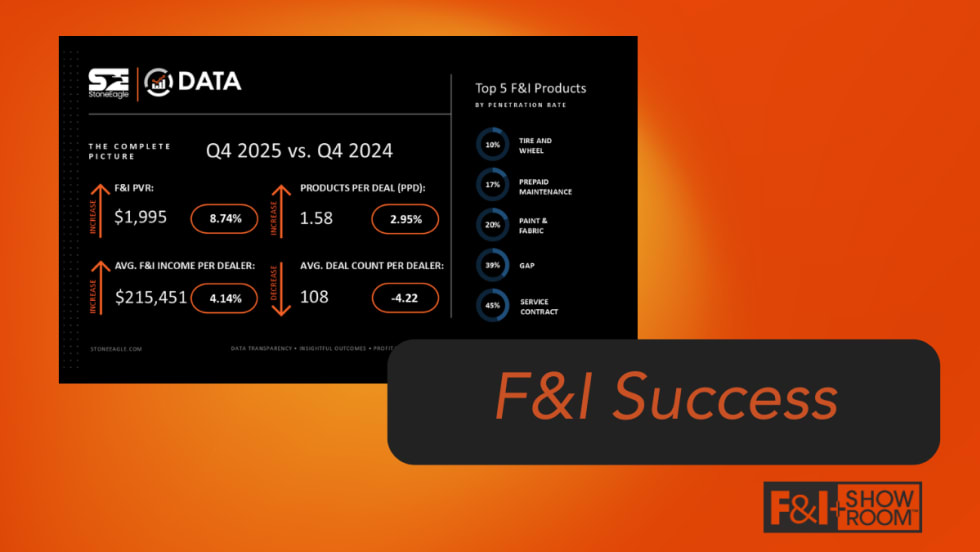
Deal volume ebbed and flowed throughout 2025, but product performance remained steady, according to automotive technology and data intelligence solutions provider StoneEagle.
A TransUnion study found that relationship-driven sales models proved to be important, as consumers who used an agent had a lower shopping intensity than those going it alone.
In this video, Reese Dailey of the Automotive Training Academy by Assurant reveals strategies to make cash deals profitable without relying on monthly payment bumps.