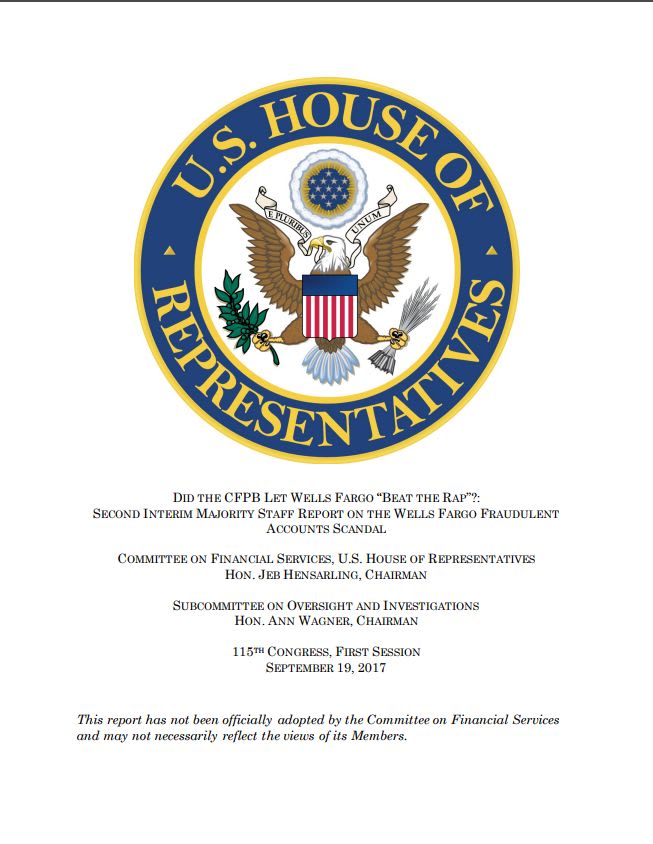
WASHINGTON, D.C. — In a 32-page staff report published on Sept. 19, the House Financial Services Committee charged the Consumer Financial Protection Bureau (CFPB) with failing to “fully and adequately investigate” the Wells Fargo fraudulent account scandal, and, instead, settled with the bank for less than 1% of the bureau’s own estimate of Wells Fargo’s statutory monetary penalty.
Chaired by Jeb Hensarling (R-Texas), the committee’s latest charges are based on an internal CFPB memo it obtained on Sept. 5 as part of its review of the bureau’s handling of the Wells Fargo investigation. Dated July 12, 2016, the “Recommendation Memo,” which the committee alleged was withheld by the CFPB for more than a year, laid out the bureau’s case against Wells Fargo and sought authorization to enter into settlement negotiations with the bank.
“The CFPB’s handling of this matter and its refusal to fully comply with the Congressional subpoena are a slap in the face to millions of Americans who were harmed by Wells Fargo and further evidence of the CFPB’s unaccountable structure and leadership,” said Hensarling. “The premature suspension of its investigation means that the CFPB also potentially lost the opportunity to discover recently revealed instances of further consumer harm.”
The committee said the memo calls into question the accuracy of the CFPB Director Richard Cordray’s testimony before Congress, adding that the committee is unable to complete its investigation of Wells Fargo’s fraudulent account scandal because the director “remains in default of the committee’s April 2017 subpoena.”
“Furthermore, in records discovered by the committee and made public in the report, Director Cordray, other senior CFPB officials, and CFPB oversight attorneys appear to have deliberately withheld the Recommendation Memorandum and other key records in response to the committee’s records requests and subpoenas,” the committee stated, in part. “Some CFPB officials even appear to have taken affirmative steps to attempt to conceal the Recommendation Memorandum’s existence from the committee.”
In September 2016, Wells Fargo revealed that its employees may have created more than two million accounts without customer approval. The number of accounts has since reached 3.5 million, the bank said on Aug. 31.
That revelation came on the heels of the bank’s July 27 announcement that 570,000 car buyers “may have been harmed” due to issues related to auto collateral protection insurance policies (CPI) sold between 2012 and 2017. Officials said approximately $64 million in cash remediation would be issued to consumers in the coming months, along with $16 million of account adjustments.
Within days of that announcement, The New York Times reported that the bank was facing new charges that it failed to properly compensate car buyers who purchased GAP coverage through Wells Fargo Dealer Services and paid off their loans ahead of schedule. According to the report, the GAP issue was uncovered in the course of an external inquiry ordered by the Federal Reserve Bank of San Francisco, where Wells Fargo is based. In a statement sent to the newspaper, however, spokeswoman Jennifer Temple said the company “discovered issues related to a lack of oversight and controls” during an internal review.
“We are reviewing our practices and actively working with our dealers and have already begun making improvements to the GAP refund process,” Temple’s statement read, in part. “If we find customer impacts, we will make customers whole.”
Citing the CFPB’s Recommendation Memo, the committee charged that the bureau could have uncovered the CPI and GAP refund issues if it hadn’t rushed to settle with Wells Fargo. “By causing our investigation to attempt to resolve this matter, we risk failing to identify similar sales-integrity issues involving other products or developing theories for why the practices identified may violate other laws within the bureau’s authority,” reads the CFPB memo, in part.
“The Legal Division perceives optical and legal risks in advancing only UDAAP (unfair, deceptive or abusive acts or practices) claims for conduct that may also violate other federal consumer financial laws, but we (and the Legal Division) believe those risks are outweighed by the benefits of proceeding quickly,” the memo continues. “… Given the seriousness of the violations we have identified, and the significant penalties associated with them, we see little upside to continuing our investigation in hope that we might find more.”
In September 2016, the CFPB announced its $100 million with Wells Fargo, the largest fine the bureau had ever imposed. The bank, which did not admit to any wronging, also agreed to pay $50 million to the city and the county of Los Angeles, where the unauthorized accounts were first uncovered by the Los Angeles Times in 2013, and $35 million to the Office of the Comptroller of the Currency.
The committee, however, said the CFPB’s Recommendation Memo shows that the bureau estimated the bank’s potential liability for a statutory monetary penalty could have exceeded $10 billion.
“At a minimum, information revealed in the Recommendation Memorandum does not corroborate Director Cordray’s congressional testimony that the CFPB conducted an ‘independent and comprehensive investigation’ of Wells Fargo and also raises questions as to the accuracy of the director’s testimony before the Senate Banking Committee on September 20, 2016, before this committee on April 5, 2017, and in his June 14, 2017, letter to Chairman Hensarling in response to the committee’s June 2017 Interim Staff Report,” the committee stated.