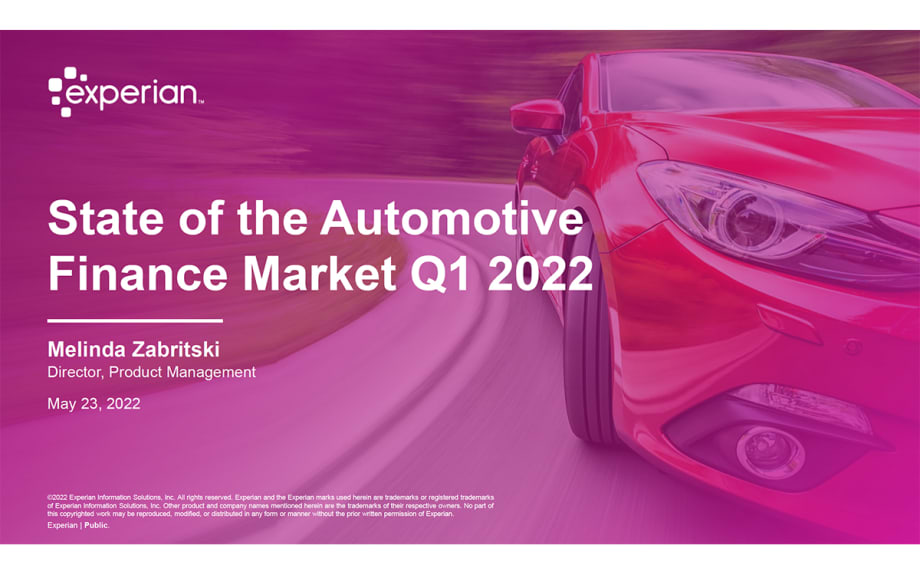
SCHAUMBURG, Ill. — Through the first three months of 2022, there were some shifts in the automotive finance market, most notably, significant growth for credit unions.
According to Experian’s State of the Automotive Finance Market: Q1 2022 report, credit unions amassed 22.06% of the total automotive finance market, up from 18.55% a year prior.
The credit union growth is concurrent with a drop in market share for captives, which declined from 29.75% to 25.38% year-over-year. The data also showed more modest year-over-year growth for banks (up 2%) and finance companies (up 4%).
“With low inventory and high consumer demand, we’re not seeing nearly as many incentives on the market. This has resulted in an opportunity for credit unions to step in and gain market share, as they often offer the lowest interest rates,” said Melinda Zabritski, Experian’s senior director of automotive financial solutions. “Credit unions tend to focus on the used vehicle market and given the ongoing inventory shortages reducing availability of new vehicles and increasing demand for used, it makes sense to see this kind of increase in market share.”
Used vehicle financing comprised 58.98% of all vehicle financing in Q1 2022, with new vehicle financing making up the other 41.02%, compared to 57.37% and 42.63%, respectively, in Q1 2021. Breaking down new vehicle financing further, leasing continued to decrease year-over- year, making up 21.31% of new vehicle financing in Q1 2022,compared to 28.31% this time last year.
Average vehicle loan amounts and payments continue to rise
Additional impacts of the ongoing inventory shortage include increases in average vehicle loan amounts andmonthly payments, for both new and used vehicles. The average new vehicle loan amount went up nearly 12% year-over-year, increasing from $35,385 in Q1 2021 to $39,540 in Q1 2022, while the average used vehicle loanamount rose nearly 25% year-over-year, to reach
$27,945, up from $22,378 in Q1 2021. Meanwhile, the average new vehicle monthly payment increased $71year-over-year, reaching $648 in Q1 2022, while the average monthly payment for used vehicles reached $503, up $89 year-over-year.
Despite the average loan amounts and monthly payments rising, average interest rates and loan terms remained more level year-over-year, and even seeing some slight decreases. The average interest rate for a new vehicledecreased from 4.15% in Q1 2021 to 4.07% in Q1 2022, while the average interest rate for a used vehicle dipped from 8.82% to 8.62% during the same time frame. The average loan term for new vehicle saw a slight decrease, from 69.50 months in Q1 2021 to 69.48 months in Q1 2022. Used vehicles saw an uptick in average term, as it reached 67.65 months in Q1 2022, up from 65.73 month in Q1 2021.
“We’re continuing to see the inventory shortage reflected in financing attributes, especially with used vehicle values continuing to rise so significantly due to demand,” Zabritski continued. “Staying close to the data will be key for lenders and dealers to make informed decisions, and help consumers find the right vehicle for their needs and budget in the quarters to come.”
Additional findings for Q1 2022: