CFPB Issues Rule Banning Arbitration Clauses in Finance Contracts
The new rule is set to take effect 60 days after publication in the Federal Register. It comes more than two years after the bureau studied mandatory arbitration clauses and one year after it proposed to ban such clauses in consumer finance contracts.
WASHINGTON, D.C. ─ Two years after studying it and more than a year after proposing to ban finance companies from blocking consumers from joining group lawsuits, the Consumer Financial Protection Bureau (CFPB) today issued its anticipated rule prohibiting the use of mandatory arbitration clauses in finance contracts.
According to CFPB officials, the bureau received 110,000 comments after it issued its proposed rule in May 2016 and request for public comment. The finalized rule is set to take effect 60 days following its publication in the Federal Register and applies to contracts entered into more than 180 days after that.
Ad Loading...
“Arbitration clauses in contracts for products like bank accounts and credit cards make it nearly impossible for people to take companies to court when things go wrong,” said CFPB Director Richard Cordray. “These clauses allow companies to avoid accountability by blocking group lawsuits and forcing people to go it alone or give up. Our new rule will stop companies from sidestepping the courts and ensure that people who are harmed together can take action together.”
Arbitration clauses typically state that either the company or the consumer can require that disputes between them be resolved by privately appointed individuals, or arbitrators, except for individual cases brought in small claims court. The CFPB charged that finance sources use such clauses to block class action suits, which allow a few consumers to pursue relief on behalf of everyone who believes they were harmed by a company’s practices.
Almost all mandatory arbitration clauses, the CFPB further charged, force each harmed consumer to pursue individual claims against the company, no matter how many consumers are injured by the same conduct. The bureau added that consumers almost never spend the time or money to pursue formal claims when the amounts at stake are small.
That was one of the conclusions of the bureau’s report on arbitration clauses, which was released in March 2015. It also showed that at least 160 million class members were eligible for relief over the study’s five-year examination period. Settlements during that study period totaled $2.7 billion in cash, in-kind relief, and attorneys’ fees and expenses.
The study, which also reviewed more than 1,800 consumer finance arbitration disputes ruled over a three-year period beginning in 2010 and more than 3,400 individual federal lawsuits, found that consumers were awarded less than $175,000 in damages and less than $190,000 in debt forbearance in arbitration suits vs. just less than $1 million in federal lawsuits.
Ad Loading...
But industry groups and legal insiders said not all findings in the study supported the elimination of mandatory arbitration clauses. They point to findings related class action cases where the principal purpose of seeking class relief was to pressure a settlement. According to the study, members of such class actions received either nothing or next to nothing.
The study also found that class action cases almost never make it to trial, while a significant percentage of arbitration proceedings actually resolve the disputes, the study’s critics said last year when the CFPB first proposed its ban on arbitration clauses.
“Late last year, the CFPB released a study on arbitration, which the bureau says shows that consumers are harmed by arbitration agreements as opposed to class action lawsuits. However, a careful review of the CFPB’s study demonstrates that the opposite is true …” the American Financial Services Associated stated at the time. “In 60% of class actions studied by the CFPB, consumers received no remuneration at all.
“In the 15% of cases where consumers received monetary compensation in class actions, they received an average of just $32.25, after waiting an average of 23 months,” the association added. “In contrast, consumers who prevailed in arbitration agreements, on average, received $5,389. The real winners in class action lawsuits are plaintiffs’ attorneys, who divided approximately $424 million in fees.”
In today’s announcement, the bureau highlighted another finding in its report — that three out of four consumers the bureau surveyed did not know whether their credit card agreement had an arbitration clause.
Ad Loading...
Under the new rule, companies can still include arbitration clauses, but creditors subject to the rule can’t use arbitration to stop consumers being part of a group action. The rule also includes specific language that companies will need to use if they include an arbitration clause in a new contract.
The rule also requires companies to submit to the CFPB certain records, including initial claims and counterclaims, answers to these claims and counterclaims, and awards issued in arbitration. The bureau will also collect correspondence companies receive from arbitration administrators regarding a company’s nonpayment of arbitration fees and its failure to follow the arbitrator’s fairness standards.
Bureau officials said the collected materials, which must be submitted with appropriate redactions of personal information, will allow it to better understand and monitor arbitration. They will also be published on the bureau’s website beginning in July 2019.
The new rule applies to the major markets for consumer financial products and services overseen by the bureau, including those that lend money, store money, and move or exchange money. Congress already prohibits arbitration agreements in the residential mortgage market and has done the same in many forms of credit extended to servicemembers and their families.
Exempted from the new rule are employers who offer consumer financial products or services for employees as an employment benefits; entities regulated by the Securities and Exchange Commission or the Commodity Futures Trading Commission, which have their own arbitration rules; broker-dealers and investment advisers overseen by state regulators; and state and tribal governments that have sovereign immunity from private lawsuits.
Ad Loading...
In October 2015, the bureau published an outline of the proposals under consideration and convened a Small Business Review Panel to gather feedback from small companies. The bureau also sought comments from the public, consumer groups, industry, and other interested parties before continuing with the rulemaking, bureau officials noted.
“Originally, arbitration was primarily used for disagreements between two businesses. But over the last quarter century or so, companies started adding arbitration clauses to their consumer contracts, specifically to block group lawsuits and avoid legal accountability,” Cordray said “… Today’s rule prohibits banks and other consumer financial companies from including mandatory arbitration clauses that block group lawsuits in any new contracts after the compliance date.
“… By restoring the ability of consumers to file or join group lawsuits, the rule gives companies more incentive to comply with the law,” he added. “And the deterrent effect of such cases can more broadly influence the business practices of other companies as well.”
A spokesperson for the National Automobile Dealers Association said the trade group is reviewing the rule. The National Independent Automobile Dealers Association, however, didn't hide its disappointment in a statement issued today, noting that the rule will force small business to bear the additional cost of defending class action litigation — a cost that "will ultimately be borne by consumers."
"We are disappointed that the bureau has decided to adopt this ill-conceived rule," said NIADA CEO Steve Jordan, adding that the association will urge lawmakers to overturn the rule when Congress considers CFPB reform. "Today's action shows the CFPB has decided to put the interests of class action lawyers above those of the very consumers the bureau is mandated to protect.
Ad Loading...
"Arbitration has proven to be a faster, less expensive and more effective means of resolving consumers disputes than class-action lawsuits," he continued. "And consumers who receive an award in arbitration almost always receive more than they would in a class-action lawsuit, a point proven by the CFPB's own research."
In this video, Reese Dailey explains how effective follow-up drives better results
across the dealership, including increased sales, higher F&I penetration, and
stronger customer retention.
It may be human nature to back off when a customer seems to say no to a product or service. But experts say F&I managers should operate as though the answer will be the opposite.
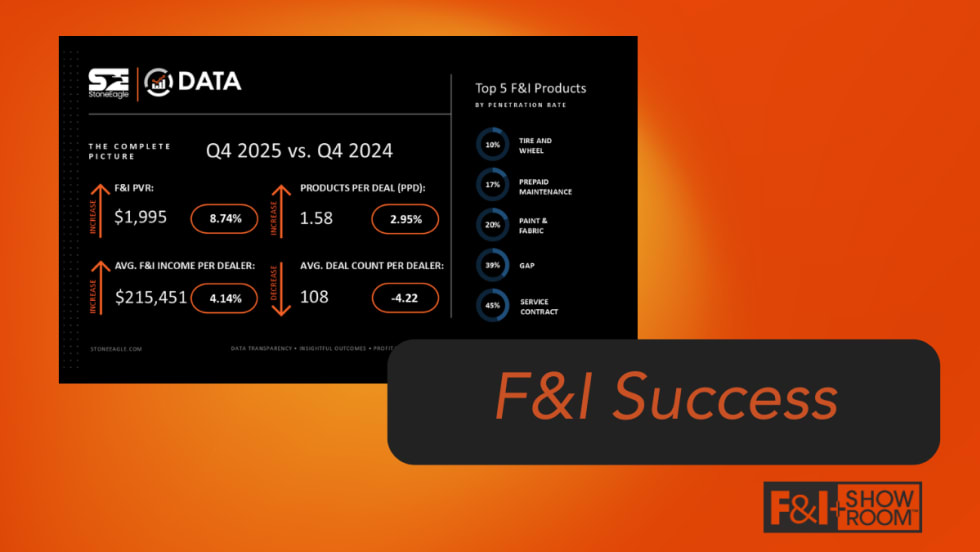
Deal volume ebbed and flowed throughout 2025, but product performance remained steady, according to automotive technology and data intelligence solutions provider StoneEagle.
A TransUnion study found that relationship-driven sales models proved to be important, as consumers who used an agent had a lower shopping intensity than those going it alone.
In this video, Reese Dailey of the Automotive Training Academy by Assurant reveals strategies to make cash deals profitable without relying on monthly payment bumps.