In an unexpected decision, California Gov. Jerry Brown vetoed a dealer protection bill unanimously passed by the California State Legislature. The sticking point was a 'complex formula' for determining dealer reimbursement on warranty and recall work.
UPDATED on 10/2/18: The article now includes statements from the California New Car Dealers Association.
SACRAMENTO — Gov. Jerry Brown rejected a bill lobbied for by the state dealer association and unanimously passed by the California State Legislature, returning AB 2107 without his signature due to modifications the legislation called for in the way auto manufacturers reimburse dealers for warranty and recall repairs.
Ad Loading...
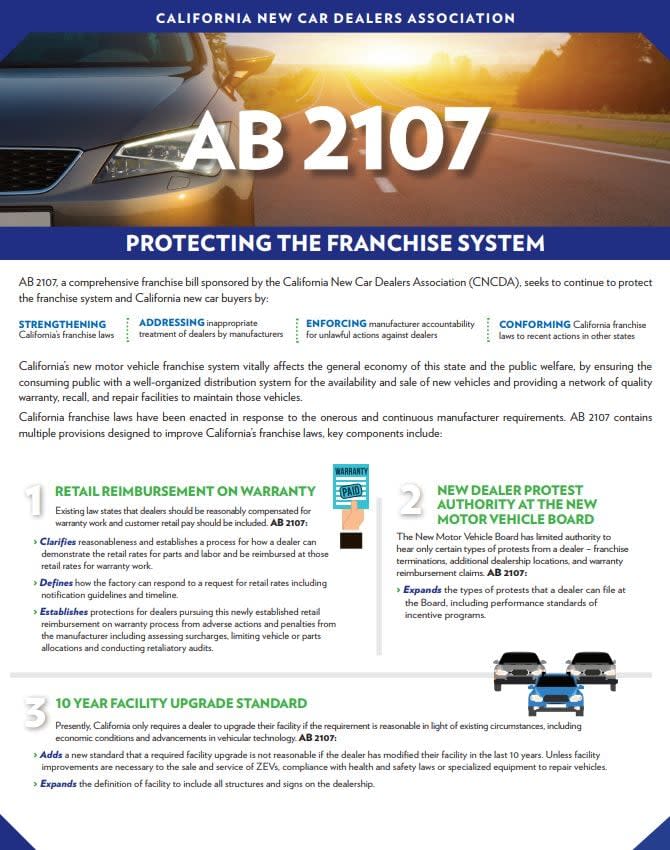
The wide-ranging bill was designed to strengthen and update California’s new motor vehicle franchise laws in nine specific areas. Gov. Brown, whose veto of the bill was unexpected, laid out his concerns for one of those provisions in a letter to members of the California State Assembly, which had passed the bill by a 77-0 vote on Aug. 30.
“Under current law, manufacturers are required to reimburse dealers for warranty and recall repairs at a ‘reasonable’ rate negotiated between the two parties,” Brown wrote, in part. “This framework appears to be working reasonably well and I see no reason to adopt the rather complicated formula authorized in this bill — with perhaps unintended consequences.”
The bill would have clarified what “reasonable” means and established a process for how a dealer can demonstrate the retail rates for parts and labor and be reimbursed at those rates for warranty work. It would have also defined how the factory can respond to a request for retail rates, including guidelines and timelines.
Brian Maas, president of the California New Car Dealers Association, said there is nothing complicated about the formula, noting that it is included in state statutes for more than half the country. “You take recent repair orders that are qualifying, and you establish a retail labor rate,” he said. “And we use the manufacturers [time allowances] to calculate how much dealers are going to get paid.
“Frankly, it’s not all that complicated,” Mass added. “It’s detailed, for sure. It goes on for a few pages. It’s specific, for sure. But it’s not unprecedented, and is based off the successful work of dealer associations across the country that worked with their respective state legislatures.”
Ad Loading...
The legislation would also have established protections for dealers pursuing this newly established retail reimbursement on warranty process from adverse actions and penalties from the manufacturer, including assessing surcharges, limiting vehicle or parts allocation, and conducting retaliatory audits.
“If you read the governor’s detailed message, he assumes warranty reimbursement rates are negotiated between manufacturers and dealers. That’s not our dealers’ experience,” Maas said. “The manufacturers decide what they’re going to pay. The dealer has two choices: They can either take it or they can try and challenge them with a protest or a court action. So that’s why we think, respectfully, the governor just missed this one.”
The legislation would also have expanded the types of protests dealers can file with the state’s New Motor Vehicle Board regarding manufacturer encroachment. It would also have deemed a facility upgrade requirement as unreasonable if a facility was modified in the last 15 years, and builds upon existing law requiring that all performance standards be reasonable with a dealer’s demographics, market characteristics, allocation, local and state economic circumstances, and historical performance of the line-make.
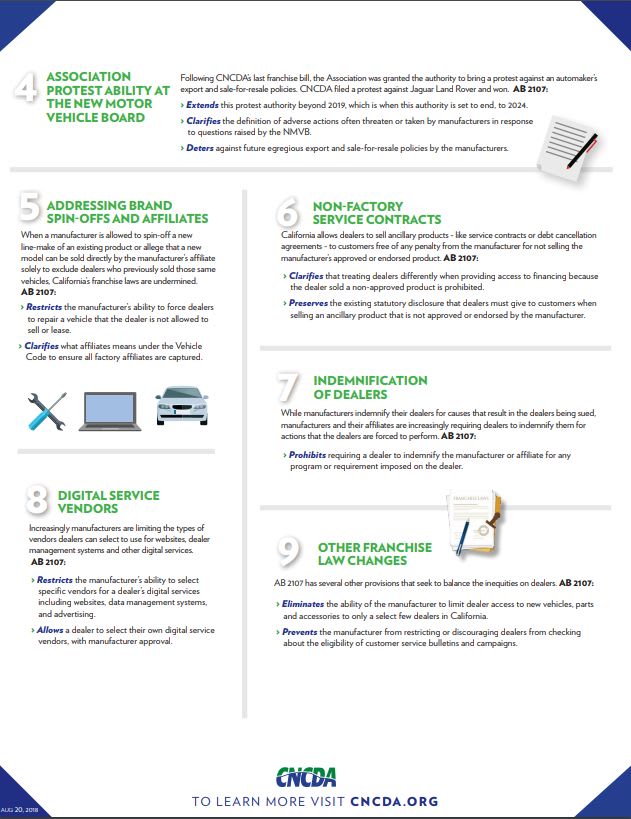
Additionally, the bill would have allowed dealers to select their own digital service vendors, restricting manufacturers from selecting specific vendors for their dealers to use. It also restricts a manufacturer’s ability to force dealers to repair a vehicle that a dealer is not allowed to sell or lease.
The legislation would have also preserved the state’s existing statutory disclosure dealers are required to give to consumers when a non-OEM endorsed F&I product is sold, thereby prohibiting OEMs from instituting their own disclosure form as General Motors did last summer. The bill also clarifies that treating dealers differently when providing financing or advancing money because the dealer sold a non-approved product is prohibited.
Ad Loading...
Stripped from the approved legislation, however, was a proposed statewide ban on automakers engaging in direct-to-consumer sales. The language would have modified the state’s existing guideline, which states that an automaker can’t compete against a same-brand dealership within a relevant market area.
Another provision stripped from the bill earlier this summer would have banned automakers from offering subscription programs unless they use their dealers to operate them.
Particularly disappointing to Maas regarding Gov. Brown’s veto is the bill would have reinstated a provision regarding manufacturer export policies. The state currently prohibits manufacturers from imposing chargebacks and other penalties when a dealer is unaware of an intended exportation or resale of a vehicle and authorizes associations to file protests with the New Motor Vehicle Board to enforce California law on manufacturer export policies. Maas said that authority is set to expire on Jan. 1, 2019, which means the association will have to go back to the legislature to have that provision reinstated.
As for the bill, Maas said the association is now working with its author to decide when and how they’re going to reintroduce it. More than likely, that will happen after Gov. Brown’s term ends on Jan. 1, 2019. “They’ll be another governor of California,” he said, “and we’re going to work hard to put this bill on the next governor’s desk.”
Get caught up on the most pressing legal and regulatory matters facing dealers and F&I professionals, including data security, shotgun purchases, and inconsistent payment quotes.
Civil penalties for noncompliance with federal auto retail and finance rules and regulations can add up quickly. Use this checklist to cover your bases.