The current market environment will definitely separate the survivors from the victims. F&I expert provides a road map for doing more than just weathering today’s economic storm.
When the car business is
good, it’s great! Right now, however, all we’re talking about is survival. Two
things happen when business is bad. First, a down market separates the
survivors from the victims. Second, it creates tremendous opportunities for the
survivors. In times like these, survivors don’t give up, make excuses, or have
pity parties. They get up every morning looking for ways to turn every
challenge into an opportunity to become better at their craft.
Survival of the fittest is
the ageless law of nature, but the fittest are rarely the strongest. The
fittest are those endowed with the qualities to adapt, the ability to accept
the inevitable, conform to the unavoidable, capitalize on changing conditions,
and turn those challenges into their advantage. When business is good, anybody
can succeed. But in every business downturn, there will be survivors and there
will be victims. Which will you be?
Suddenly, we have fewer
customers walking through the door, subprime lenders who have disappeared, and
more compliance flags than you can possibly wave. We have primary lenders who
won’t consider anyone with a credit score of less than a 700, finance longer
than 60 months, or look at a deal with a loan-to-value ratio of more than 90
percent. We’re seeing fewer finance customers and more cash customers. Credit
unions have become both primary sources and major competitors. So how can we
take advantage of a tough market?
Be Easy To Do Business With
The first way to take
advantage of today’s market conditions is to be easy to do business with. Is
your F&I process treating customers the same way you would treat your
mother? If not, then you need to change your process! Selling is not about
outsmarting customers, it’s about helping that human being on the other side of
the desk. Customers appreciate having someone help them make an informed
decision.
Remember, every customer
still has to buy you first. You must be enthusiastic about the outstanding
value of the products you offer, and share that excitement with your customers.
Every salesperson, every manager, and every customer has to know that you are
genuinely excited to have an opportunity to help customers.
Have fun with your customers!
It ought to be fun to buy a car, and it should be an enjoyable experience in
the F&I office as well. When they leave your office, every customer should
have a smile on their face, and be glad they had a professional take the time
to review their options and help them make the right decision.
Being easy to do business
with also requires that you not fall in love with your process. Processes don’t
sell products, technology doesn’t sell products, and menus don’t sell products.
People do!
F&I Must Operate Separately
To turn up F&I profits in
a down market, the F&I department must be a separate department, not a
secretarial service for the sales department. In many dealerships, salespeople
take the credit application, the sales manager submits the deal to a lender,
negotiates the down payment, monthly payment and the rate before an F&I manager
even talks to a customer. Then the F&I “secretary” is responsible for
typing up whatever the sales department negotiated. That’s not a department,
that’s a secretarial service for the sales department.
The commitment to F&I as
a separate department starts at the top, with the dealer or general manager.
Every dealership needs a checks-and-balances system to ensure the information
on the credit application is correct, and what is being submitted to a lender
is correct. Someone must check every deal to make sure no one is coaching
customers, doctoring credit applications, or power booking vehicles just to get
an approval. Inflating a customer’s income or adding imaginary options to
increase the amount a lender will advance on a vehicle is not fudging the figures,
it’s a felony.
There are also new rules and
risks when it comes to quoting payments. Customers are entitled to accurate
monthly payment quotes. When they don’t get them, it’s deceptive and unlawful.
So, what’s in your deal jacket? Do the payments on the deal sheet or worksheet
bear any resemblance to reality? Who’s making sure no one is packing payments
or creating a legal liability by promising customers they’ll get the best rate
possible?
No deal should ever be
submitted to a lender until a F&I professional confirms all the information
on the credit application, and has interviewed the customer regarding his or
her credit history. Prior to submitting the credit application, a F&I
professional has to learn the circumstances and details surrounding any adverse
credit information disclosed by the customer or revealed by the credit bureau
report. Every customer has a story, and it’s the F&I manager’s job to hear
it, document it, and then paint a picture for a paper buyer as to why he or she
should buy the deal or change a tier level.
[PAGEBREAK]
Keep it Between the Buoys
Turning up F&I profits
also requires that every dealership establish parameters for the sales desk
with regard to quoting payments. These parameters should include the maximum
loan-to-value ratios, term, debt-to-income ratios, and payment-to-income
ratios.
Any payment quoted before
obtaining a credit bureau report should be based on an average rate (a finance
rate grid should be used after obtaining a credit bureau report) to ensure
consistency and compliance. Do not make exceptions. The customer’s actual rate
is provided by the F&I manager once the loan is approved.
Those parameters must also
stipulate that there can be no packed payments by anyone, anywhere, anytime.
There should be no “low-ball” rates, either. A 419 FICO score does not equal a
4.19 percent rate.
The parameters should include
a maximum payment range on any payment quote of $5, taking into consideration
the number of days to first payment. There can be no fudging the figures. Any
payment quote should also include disclosure of the down payment, amount
financed, term, and annual percentage rate. The F&I department should be
solely responsible for converting outside finance and cash customers to
dealership financing. The sales department is responsible for selling the car,
not the financing.
Finally, the F&I
department submits every deal, not the desk. A F&I professional is
responsible for ensuring proper deal structure prior to submitting the
application to a lender, monitoring the dealership’s portfolio mix and
look-to-book ratio, knowing each lender’s scoring system, and utilizing lender
leverage to obtain an approval.
Sell Customers What They Can Afford
When we sell customer’s what
they can’t buy, they don’t buy. Turning up F&I profits requires we go back
to the fundamental concept … sell customers what they can afford. Salespeople
should attempt to switch every customer up front, not after they can’t buy what
they already sold them. Here’s an easy way for a salesperson to switch a
customer:
“We find a lot of customers
who come in looking for a new car decide to buy a certified pre-owned instead,
because they can save $3,000 to $4,000, and have a payment that’s $75 to $100
less per month. Before we drive your new car, is that something you would like
to consider as well?”
Mentally switching customers
upfront allows them to save face when they select more car than they can
afford. It also provides price and payment protection for the salesperson when
the customer objects to the first pencil. If they accept the switch, they
should demo the switch vehicle first. Salespeople have to determine what
customers can afford before they commit to buying what they can’t.
It’s also time to forget the
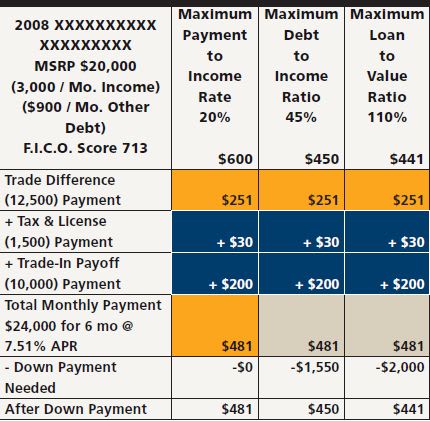
four-square and give customer’s a three-column (see illustration).
[PAGEBREAK]
We’ve taken the
smoke-and-mirror approach about as far as it will go. Today, we have to educate
customers as to what they can afford, and help them see the benefits of equity.
They also need to see a breakdown of the monthly payment trade difference,
payoff on their trade-in, and tax and license fees. In other words, educate and
inform customers, do not obfuscate and confuse them.
Implement an F&I Wellness Program
Finally, to turn up F&I
profits you must implement an F&I wellness program. Greet the customer in
the salesperson’s office, get involved early in every deal, and manage by
wandering around the dealership.
Add value to the customer’s
purchase experience by educating and informing him orher about their options.
Become valuable by educating and informing customers about financing. Help them
obtain acceptable financing by reviewing their credit application and their
credit bureau report prior to submission to a lender. This will allow you to
paint a clear picture of their financial situation for your lenders. Help them
understand your lenders’ guidelines, their FICO score, and how they can dispute
errors in their credit bureau report.
Use technology to improve
communication and trust. Let your customers see you enter their information
into the computer, submit their deal, and customize a menu based on their
needs. Exceed their expectations by giving customers more than they ask for.
Concentrate on what is best for the customer. Sell products based on their
agenda, not your agenda. Utilize needs-based selling, not greed-based selling.
Require a F&I manager to
talk to every customer with a FICO score below 740 prior to submission to a
lender. The F&I manager must also review the credit application prior to
submission. The F&I manager is solely responsible for selling F&I
products, and financing is a product. And finally, utilize an ongoing training
program that tracks individual training activity.
Survivor or Victim?
If you want to turn up
F&I profits, be easy to do business with. Treat people the way you’d want
to be treated. F&I must also be a separate department, not a secretarial
service for the sales department. Your dealership must also establish
parameters for the desk with regard to quoting payments before and after
obtaining a credit bureau report.
Additionally, salespeople
have to sell customers what they can afford. We must also use a three-column to
educate and inform customers about their monthly payment and the criteria
lenders use to evaluate a deal. Finally, you need to implement an F&I
wellness program to ensure you become valuable to customers, salespeople, the
desk, your lenders, and the dealership.
In a down market, you will
either be a victim or a survivor. You choose.
Ron Reahard is president of Reahard & Associates
Inc., an F&I training company providing F&I classes, as well as
in-dealership and online training. He can be contacted at
ron.reahard@bobit.com.