What to Consider Before Taking the Plunge
Dealers, energy experts share guidance on deciding whether to go solar, and how.
If an auto dealer is considering switching to solar for one or more stores’ power needs, the factors determining whether it’s the right fit are numerous and complicated.
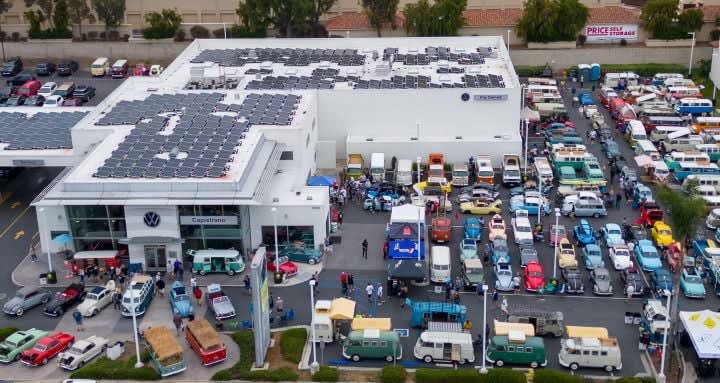
California dealer Miles Brandon sensed that early on when he started to entertain the idea after a solar vendor contacted him. Though the concept seems like an obvious winner, it depends on various, often interconnected circumstances that call for outside help.
Considerations
Dealers considering solar could benefit from the learning process Brandon undertook with his own project. He says he’d advise them to talk with multiple vendors, first of all, because solar vendors have different approaches. He also brought in his building contractor, electrician and electrical contractor to help him interview the candidates.
“We got proposals from five vendors – you learn a lot,” he said. “They all had their math formulas that showed the payback.”
In the case of Brandon’s Volkswagen dealership, the roof was 20 years old at that point, so he decided to replace it in case the old one had leaked and required him to remove solar panels.
The panels are the heart of a solar system, and the roof must be strong enough to bear their weight, says Maria Vargas, director of the U.S. Department of Energy’s Better Buildings Initiative, which helps businesses research solar.
“You’re looking for big uninterrupted spaces on a relatively new roof,” adds Will Kenworthy, who used to install solar systems and now serves as regulatory director for the nonprofit Vote Solar group.
First Things First
Before an auto dealer does anything else in their research of solar, they should take two essential first steps, Vargas advises.
“They should understand how much energy they’re using. When they sell or fix cars, that’s not always top of mind,” she says. “The second thing is have you become as energy-efficient as you can be? Once you understand both those things, then you can start thinking about what your energy needs are for the future.”
Future needs include how much electricity a dealership may need to charge the electric vehicles it will be selling, in addition to regular facility electricity demands.
The Right Conditions
It almost doesn’t bear mentioning that sunnier areas make solar especially practical.
If the setting and facilities are a good match, dealers should then look into electricity rates in their area and how much they’d get compensated by their electricity utility for sending power back to the grid from a solar array. Some utilities pay private solar producers like auto dealers at much lower rates than others, typically based on the market value of electricity, Kenworthy says. States and utilities determine compensation rates.
“What I spend half my time doing is fighting over the utility costs they should be compensating the customer for. In some places it’s an eighth of retail rates. That can drive the profitability of the system” if a dealer doesn’t use all the power it generates.
Some states, in addition to the federal government, offer incentives for solar installations, he adds. “That can really drive the economics.”
If all of the conditions are right, solar can pay for itself and then pay dividends over the long haul.
“If you have really high energy rates and invest in a solar system, it’s going to pay itself back very, very quickly,” Vargas says. “For some auto dealerships, it’s within a year … then you’re making money the fifth, sixth, seventh year.”
Most photovoltaic panel solar systems have a lifespan of at least 30 years to 35 years, according to the DOE.
Don’t Decide in Isolation
Kenworthy agrees with Brandon that dealers should consult solar experts as part of their research.
“You really do need a specialized solar contractor who’s familiar with the finance aspects of these kinds of transactions – it can be very profitable, but it can be somewhat complicated,” he said, adding that dealers should also consult their tax advisers and lawyers.
The dealer’s local utility can also be an “important partner” that can inform about the rules around solar energy, including state-specific permitting, along with reputable vendors to consult and available incentives, Vargas said.
In one scenario, installation financing is built in by a third party that in some cases owns the system.
The Bonnell Motors Ford dealership in Winchester, Mass., recently tapped commercial solar loan platform Sunstone Credit to finance its $1 million solar installation, but Bonnell owns its system. The 99-year-old store decided to invest in it to underpin its increased electric-vehicle sales and to use clean energy overall.
The store and Sunstone worked with solar builder, owner and operator 621 Energy on the installation, which took three months, and Bonnell said the dealership made the change a lot sooner than it thought it could through the financing arrangement and “instantly started saving thousands on our electric bill.”
President Steven Bonnell said in a press release on the project, “We considered a number of solutions to reduce our carbon footprint and save on utility costs, and going solar seemed like the perfect answer.”
Considering Solar?
Take these steps to help you decide:
Ask your electricity utility for local rules, incentives, and to recommend reputable vendors.
Tap your electrical contractor for any guidance it has about solar.
Consult with energy consultants who can help you sort through the factors, especially in states with competitive energy markets. You can start with state solar energy associations, some of which vet companies on their rolls; brokers for competitive retail electric services; and the national trade group Solar Energy Industries Association.
Check the U.S. Department of Energy’s Better Buildings Initiative about federal tax incentives.
Talk with auto dealers that have already switched to solar about their experience.
Interview several vendors with the help of your trusted contactors, tax adviser and attorney to determine which would be the right fit for you.