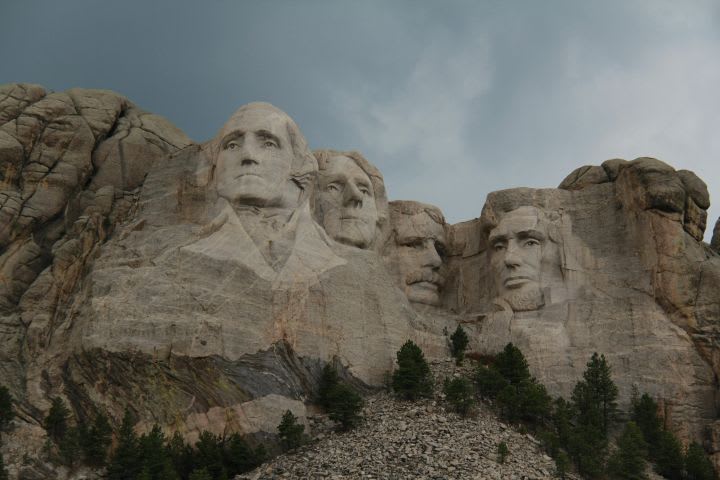
All four figures on Mount Rushmore, known as America's Shrine of Democracy, supported tariffs. Does that mean that the United States of America should endorse tariffs in 2025?
The debate regarding tariffs, with most economists disparaging them and a minority supporting, recalls an anecdote:
An economist is passing a ranch and notices a pasture filled with sheep. He stops his car and makes the rancher a wager. He bets the rancher that he can correctly tell him the number of sheep in the pasture and that, if he does so, he can take one of the animals. The rancher scoffs and agrees. The economist provides the correct answer, and the rancher honors the bet by allowing the economist to take one of the animals. As the economist walks away with one, the rancher bets the economist that he can guess the economist’s occupation and win back his animal. The economist agrees to the challenge. The rancher says, with confidence, “You’re an economist!” The surprised economist asks, “How do you know that?” The rancher, quite smugly, says, “You took my dog!” The point of this story, of course, is that economists can be accurate about some observations but certainly not others. There is an old quip, attributed to George Bernard Shaw, that if all the economists were laid end to end, they’d never reach a conclusion. A recent study postulated that economic prediction is only 23% accurate.
Life is short but economics long. Predicting economic outcomes is quite perilous. What and how a tariff policy will affect the American economy, and the car business, remains to be seen.
What is Autarky?
In theory, autarky, or self-sufficiency, can benefit domestic producers and businesses by limiting international competition and promoting local industries. Tariffs are a tool to advance autarky. Is the Trump administration seeking autarky through tariffs?
Schools of Economic Thought
There are numerous schools of economic theory: Austrian, classical political economy, Keynesian, Marxism, and many others, including the American School. The American School owes its origin to the writings and economic policies of Alexander Hamilton, the first Treasury secretary of the United States. It emphasized high tariffs on importsto help develop the fledgling American manufacturing base and investment.
The Science of Economics
Hard sciences, such as chemistry, and soft sciences, such as economics, attempt to describe the world and predict results. The problem with soft sciences, or social sciences, is that there are many variables that make it difficult to predict results with much certainty. Economists’ predictions of the impact of these current tariffs may not be dependable.
History in Support of Tariffs
The first major piece of legislation passed by Congress and signed into law by President George Washington was the Tariff Act of 1789. The purpose was to generate revenue and protect manufacturing. In his 1790 State of the Union Address, Washington justified his tariff policy for national security reasons, stating that free people should be able to be independent for essential supplies, particularly military supplies. Alexander Hamilton influenced Washington.
The other presidents on Mount Rushmore had these opinions about tariffs:
Thomas Jefferson initially opposed tariffs but after the War of 1812 endorsed them.
Abraham Lincoln said, “Give us a protective tariff and we will have the greatest nation on earth.”
Theodore Roosevelt acknowledged in his State of the Union address from 1902 his support for tariffs: “Our past experience shows that great prosperity in this country has always come under a protective tariff.
As recently as 1971, Richard Nixon imposed an emergency tariff due to a balance-of-payments crisis. Nixon remarked "…the import duty delights me."
Examples of Tariff Success from the Past
Numerous examples show tariffs contributing to American prosperity.
In 1816, the U.S. produced 840 thousand yards of cloth. Tariffs were then introduced and by 1820, production increased to 13,874 thousand yards. America had become self-sufficient in cloth production and didn’t need to rely upon Great Britain any further.
Tariffs were utilized from 1869 to 1900 and gross domestic product quadrupled. Budget surpluses were run for 27 straight years. The U.S. debt was cut two-thirds to 7% of GDP. Commodity prices fell 58%. The U.S. population doubled, but real wages rose 53%. Economic growth averaged 4% per year.
Under Warren Harding, Calvin Coolidge and the Fordney-McCumber Tariff, GDP grew from 1922 to 1927 and reached an apex of 7%, one of the highest on record.
It is alleged that the Smoot-Hawley Act of 1930, a tariff act, triggered the Great Depression, but various economists, such as Milton Friedman, dispute this allegation since the Depression began in 1929 and this act was a response to the depression, with a trade surplus existing that same year of its enactment.
An American Economic Quagmire
The substantial trade deficit in the U.S. continues unabated, and manufacturing, with its high-paying jobs, continues to decline.
The trade deficit in 2023 was $1.1 trillion, which was greater than the next 10 nations combined and was almost 4% of the GDP. This deficit has grown from $541.6 billion in the past two decades. Conversely, China had the largest trade surplus of $539.9 billion in that time, with Germany coming in second with a $249.9 billion surplus. An important statistic is that the automotive industry comprises 17% of Germany’s exports, with the U.S. being its primary consumer. Germany has had a trade surplus with the U.S. since 1975.
The U.S. lost five million manufacturing jobs between 1998 and 2019 while the service sector gained almost 30 million jobs. Service sector employment rarely pays as well as manufacturing employment.
Surging imports from China and the resulting growing trade deficit have had a key role in manufacturing job loss. China’s entrance into the World Trade Organization in 2001 displaced many American manufacturing jobs. In 2023, China exported $436 billion worth of goods to the United States.
The Existence of Tariffs
Tariffs exist in most countries by varying percentages depending upon the import. Trade balances are also affected by currency manipulation, tax policy, such as value-added taxes; domestic content requirements; equity ownership; environmental costs; employee-related laws; products liability; and labor costs. The calculation to ascertain these costs of trade exchange is not a simple one.
The Wrath of Economists
Vitriol regarding these tariffs has been evident in the economist community.
Economist Justin Wolfers said, “Monstrously destructive, incoherent, ill-informed tariffs based on fabrications, imagined wrongs, discredited theories and ignorance of decades of evidence. And the real tragedy is that they will hurt working Americans more than anyone else.”
Former secretary of the treasury Lawrence Summers also opined, “Never before has an hour of Presidential rhetoric cost so many people so much…”
Even Trump-honored economist Arthur Laffer stated “… the proposed tariff risks causing irreparable damage to the industry, contradicting the administration’s goals of strengthening U.S. manufacturing and economic stability.”
The Wrath of Dealers
The wrath of dealers has been roundly reported, with few voices expressing approbation for the tariffs. This anger can be explained by the anticipated increase in prices of the average vehicle, imported or domestic.
The Budget Lab at Yale, a nonpartisan policy research center dedicated to providing in-depth analysis of federal policy proposals for the American economy, estimated that auto tariffs will raise new-car prices by an average of $6,400. Based on the 25% auto tariffs Trump announced, the lab contends that new-car prices will increase by as much as 31% for imported vehicles. Automobile prices will rise 13.5% overall, while new domestic car prices will increase by 3.2%. According to Edmunds, the average price of a new car in the U.S. was roughly $48,000 in 2024. Therefore, the tariff effect could increase the price to $54,400 on average.
Conclusion
Solving long-term economic quandaries is a complex equation. Is a successful economic strategy, from the past, appropriate for the modern era, when products may be manufactured, assembled and shipped through several nations before they reach their final destination? Is globalization too efficient and powerful a development to be denied? With the rise of artificial intelligence and manufacturing automatons, can human labor be reintroduced or maintained successfully? Is the threat of tariffs a negotiating ploy to exact concessions from other trading partners? What is the time horizon for this initiative, and how long can dealers and other merchants weather the tariffs? Can domestic manufacturers summon the capacity to meet these new domestic demands for products? Will other incentives, such as tax policy, encourage domestic companies to invest in these new opportunities, and can they do so expeditiously? How will consumers respond to these policies? These, and other questions, remain to be answered.
In the novel, "The Count of Monte Cristo," the final line and piece of advice is, "All human wisdom is contained in these two words -- Wait and Hope." That advice means wait and hope for the best. Such advice is cold comfort for this maelstrom but may be the only such bromide available for the time being.
Terry O’Loughlin is director of compliance for Reynolds and Reynolds and is admitted to the Pennsylvania and Florida bars. Before joining Reynolds, he was employed by the Florida Office of the Attorney General, where he investigated automobile dealers and financing sources. He previously was a public accountant.