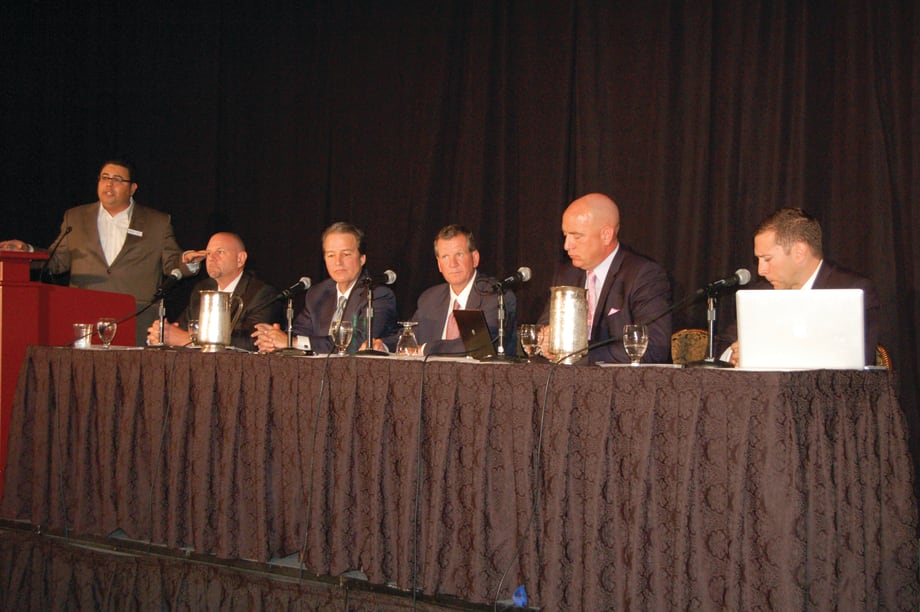
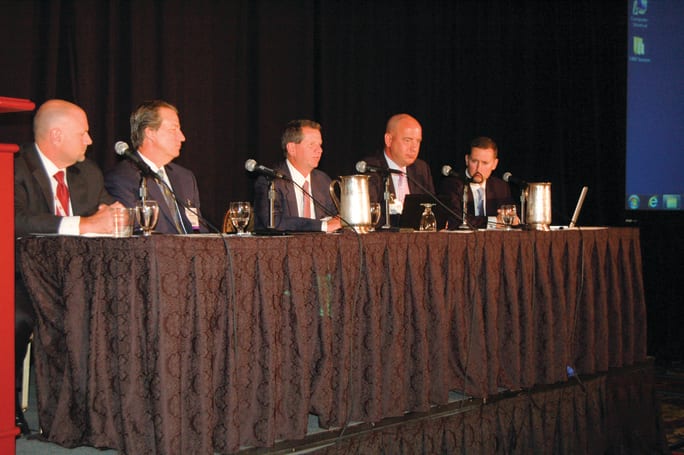
Panelists serving on this year’s Executive Panel said the industry’s drive toward recovery is revealing new opportunities for dealers, agents and product providers.
On the second day of this year’s Industry Summit, executives from four F&I product providers and an 11-rooftop dealer group convened for the conference’s annual Executive Panel. I served as moderator, and the topics we covered ranged from the mobile menu to the Consumer Financial Protection Bureau (CFPB). In the course of our discussion, panelists revealed several market opportunities for dealers and agents.
The panel included GSFSGroup’s Alan Bond, Safe-Guard Products International’s David Duncan, Innovative Aftermarket Systems (IAS)’ Jeff Jagoe, Protective Asset Protection’s Rick Kurtz, and Joel McGlamry, who oversees finance operations for Atlanta-based Hennessy Automobile Companies. The following is an excerpt of our discussion.
Ad Loading...
F&I: How do you think we’re doing in this recovery?
Duncan: Financing is back. The average age of vehicles on the road today is more than 11 years, which is a historic high. It’s unsustainable and I believe that’s what’s driving the recovery.
As a company, we look for car sales to get back to 17 million units over the next three years, but we also want to look at the opportunities that are being created by the marketplace. From an F&I opportunity, I think you need to focus on leasing. I also think we need to be focused on trucks. It’s my belief that we’re going to see the commercial market and the truck market come back real strong. And, finally, with the age of vehicles on the road today, our trade-ins are going to be older than they’ve ever been. So, you need to focus products on that.
McGlamry: I think there are some opposing forces in the world. Demand is driving the recovery. The average age of the vehicles is certainly a big factor in that, but employment is still above 8 percent. So, that remains a significant drag on the economy.
F&I: Let’s move to the used-car market. How are your companies responding to those high-mileage trade-ins?
Ad Loading...
Kurtz: Last year, franchised dealers sold 13.8 million used vehicles. Independents sold just a hair under that and private-party sales were about 11.5 million. So there were a lot of used-vehicle transactions. So, we talked with the National Independent Auto Dealer Association, major dealer customers like AutoNation and major agencies to really get an understanding of the market needs. So, we’ve studied all of that and are using what we learned for some product offerings we’re going to have for both franchised and independent dealers.
Duncan: I bought a car for my son four months ago. It was a Saturday morning in my study and I’m looking at a 100-year-old franchised dealer and Bob’s Used Cars. They both had 30 high-res pictures, clean Carfax reports and a rate calculator on their websites. So, aside from having older cars coming in on trade, you’ve also got independents that are getting more sophisticated. So, from a distribution standpoint, especially if you’re an agent, you cannot ignore the independent space any longer.
F&I: Do we have a new threshold for high-mileage vehicles?
Duncan: I think it used to be anything over 60,000 or 70,000 miles. Now it’s probably closer to 80,000 to 100,000. As a company, we just launched a whole product line for independents and for “C” lots at the franchise level, where we reduced some of the coverage to lower the price point.
Bond: We classify high-mileage cars on how long we want the term to be. So, for us, it’s any car that we would only want to provide coverage on for one to two years. But that throws us into the realm of somewhere between 110,000 and 130,000 miles.
Ad Loading...
F&I: Joel, leasing has never been an F&I manager’s friend. What have you done to change that?
McGlamry: I think it’s important to recognize the different methods you can use to measure success in leasing versus success on a finance deal. We use a metric called product PVR, where we take the total profit on a product sold and divide it by the number of vehicles sold. And this is something that allows us to kind of level the playing field to determine the F&I manager’s success. And we do have target product PVRs for both retail and leasing.
Bond: When you look at the manufacturers, most of them have very robust certified pre-owned programs. And those lease structures feed that pool of cars. So I believe they’re going to continue to push that to fuel the CPO market.
As a company, we actually have a vehicle service contract specifically designed for leases. It offers specific benefits to make it more attractive to a lease customer and offers some time and mileage options to match up with that lease.
Duncan: We learned that people pay for their cars even in dire times. And now that we’ve gone through that, and the fact that cars are much more expensive, we’ve got to figure out a way to get that payment down. Leasing may be the solution that the manufacturers concentrate on. We have to be ready to adjust to that.
Ad Loading...
F&I: What are your thoughts on the mobile menu?
Kurtz: I think you really have to look beyond the platform, because the underlying issue here is control. Customers want to have an active hand in this process. So, whether it’s a mobile menu or a change in process, the more we can involve the customer in the process, to me, Greg, that’s really the fundamental issue here.
But let me ask, how many in this room have teenage children? Their entire world is run off their handheld device, right? So, for us to say mobile menus will never take off or this will never take off, I think that’s maybe the older generations talking.
Duncan: I’m very cautious as far as the mobile menu goes. As a company, we’re going to keep looking forward and outside of the box, and we want to embrace technology on a personal level. But I’m very cautious about trying to take F&I out of the F&I office.
Jagoe: We have an interactive menu we’re beta testing right now. It does pretty much what you’re talking about, where the customer actually has control of the tablet right in front of the F&I manager. … Yeah, they’re looking at it, they’re going through it, scrolling through slides, going through laminates, but the F&I person still has to initiate everything.
Ad Loading...
F&I: What are your companies doing to stay on top of what’s going on at the federal and state levels in terms of compliance?
Bond: Well, we subscribe to Hudson Cook’s newsletters. We are constantly monitoring on a state-by-state level, and even more now on a national level. We are actively involved in organizations that have lobbyists in Washington, and we actually have our own lobbyists as well.
Duncan: We’re now stating in bold print on the front of our contracts that financing is not predicated on the customer buying the product, and that they have the right to decline the product. As far as the CFPB, I think you should look at all industries. Look at what happened to Capital One. I think it’s a good lesson for F&I managers and for dealers.
F&I: For those of you who missed it, the CFPB, in its first public enforcement action, ordered Capital One Bank’s credit card division to refund approximately $140 million to two million customers and pay an additional $25 million to the CFPB’s Civil Penalty Fund for deceptive marketing tactics employed by its call-center vendors. What’s important to note is the bank’s vendors were selling add-on products like payment protection when customers called to activate their credit cards.
Kurtz: If you’re not focusing on the bureau and you’re not familiar with the Capital One decision, you need to do so. This is a big bureaucratic institution that someone thinks is the best way to clean up our industry.
Auto loan originations rose over 6% year-over-year in the third quarter of 2025, but TransUnion predicts a slight decline in auto loan growth this year, making it an outlier in the company's overall lending forecast.
December brought some of the best borrowing availability for consumers in years, though lenders tightened their reins on riskier segments of the market.