


Legal experts Rob Cohen and Michael Charapp co-authored “Auto Dealer Law,” a legal guide covering the purchase, sale and operation of car dealerships. The two attorneys sat down with F&I and Showroom to give their candid views on the state of the industry, the future of the F&I department and what dealers can expect from the consumer protection agencies.
F&I: There’s been a lot of talk about the Consumer Financial Protection Bureau (CFPB) interfering with dealership practices, with finance reserve being the most recent example. Just how close is the F&I department to losing finance reserve?
Charapp: If finance reserve systems ended, I’m not sure what the future of the F&I department is. I don’t mean to be dark about this, but if the reserve system ended, there are certain things that will not be cost effective to keep an F&I department. I think the pressure will be extreme, but I think the system is so important to the proper functioning of the retail system among dealers that there will be pushback, so I don’t see it going away. But there are going to be some real battles over this.
Cohen: I agree. If they try to eliminate finance reserve, I don’t think that would stand legal scrutiny. Finance reserve is a significant source of an F&I manager’s income; it’s not just a kickback, as some of the plaintiffs’ attorneys and consumer groups call it. It does not actually result in consumers paying higher interest rates. That’s a falsehood.
F&I: So what do you think consumer advocates and even regulators are missing when it comes to dealer participation?
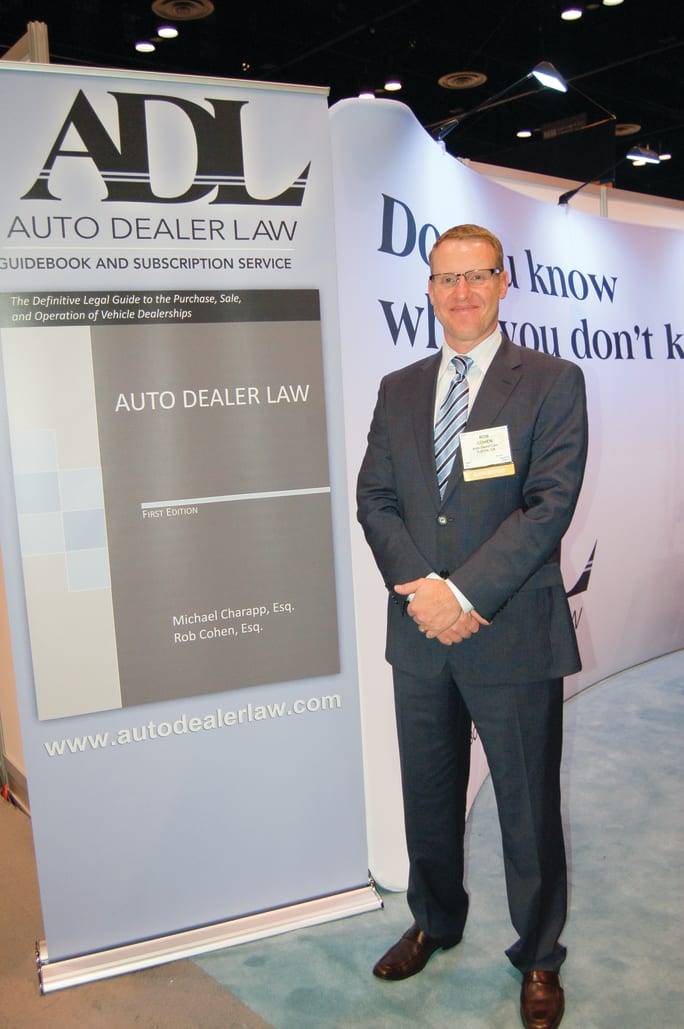
Rob Cohen is the president of Auto Advisory Services, as well as senior auto counsel at Arent Fox and director of Motor Vehicle Software Corporation.
Cohen: Dealers are a retail outlet for financing. Wholesale financing is always cheaper than retail financing. That’s the whole idea. If consumers were unable to go to dealers for their financing, there is this misconception out there that the rates would be so much lower, that these rates without the yield spread would be so much lower, that dealers are making all this unnecessary profit as a result. It’s simply not true.
Can you buy a car directly from the factory? No, you have to go through a dealership, because they’re the retail outlet. It’s the same thing with vehicle financing. You can’t go directly to Ally and get financing at the same price the dealership is getting it from Ally. It doesn’t work that way. It’s not a markup. It’s not a profit that the dealer is somehow pulling out of thin air. It exists because the dealer is doing the work to arrange the financing. They’re taking the credit application, running the credit report, doing some of the initial underwriting, collecting the information from the customer, accepting a certain amount of risk in doing the delivery of the vehicle, and they’re marketing to these customers. All of these are real, raw costs associated with financing. If the dealer’s not doing that, the finance companies have to do it. And what will that do? It will raise the rates.
F&I: Recent statements issued by the CFPB have indicated it believes consumers are being harmed by discriminatory pricing related to rate markups. What advice do you have for dealers?
Cohen: I think F&I offices need to make sure they are employing consistent pricing practices for all customers, to make sure there is no inadvertent discrimination going on from the lending perspective. They also need to make sure certain groups are not charged more for financing than other groups. I don’t know any dealers that do this intentionally.
Unfortunately, the way the federal law is, unintentional discrimination can still bring liability with disparate impact. I’m a fan of consistent pricing models. That’s what we need — consistent yield, consistent reserves — in order to combat that. Using rate sheets is a great way to ensure that certain groups of customers are not inadvertently charged more or different interest rates than others. The more discretion you give the finance office to adjust rates, the more potential liability there is to the dealership.
F&I: Online advertising still seems to be problematic for dealers from a compliance standpoint. Why is that?
Cohen: One of the largest challenges for dealers right now, depending on which state you live in, is whether there is such a thing as an Internet-only price and a showroom price. Airlines and hotels have their Internet specials. For a dealer in a state like California, if you’re advertising anywhere, you must sell at or below the advertised price. Internet-only specials aren’t allowed. And if you’re missing an expiration date for that special, you must sell it at the advertised price — even if you ran that ad in some abstract newsletter or newspaper that’s generally circulated. So you always have to have expiration dates on your ads.
But if you’re not operating in a state like California, the question remains: Can you have an Internet-only special? If you’re quoting a price electronically to one consumer, the answer is “Yes,” as that does not constitute advertising. Advertising is commuting a message or price generally. But dealers get themselves into trouble in states like California by having this great Internet price, but then they negotiate a price that’s significantly higher with a customer that doesn’t have Internet access. In California, that would be a violation of law.

Michael Charapp, partner at Charapp & Weiss, is the co-author of “Auto Dealer Law.”
F&I: Are there still areas of concern with electronic disclosures and documentation?
Charapp: When a customer has a problem with a deal, as a lawyer, I’ll call the dealership and ask to see what the customer signed. Invariably, there’s some screen that they tell me the customer saw, but they don’t have it. That doesn’t work.
Cohen: I think it’s risky to rely exclusively on digital signatures in the F&I office. There will come a time when that might work, but I suggest converting everything to paper until we have an industry standard or a definite methodology where you can establish what the customer saw on the screen and how they acknowledged it. A properly trained F&I manager should be going very carefully through all of the documents — whether electronically or otherwise — with the customer to explain everything. I think that’s a struggle we’ve had in this industry forever: properly trained finance people that can carefully and diligently explain all of the documents that the customer is signing. And that doesn’t change whether it’s in paper or electronic form.
Charapp: My rule of thumb in the car business is that if it wasn’t signed, it wasn’t seen. As a lawyer, I can’t prove they saw it if they didn’t sign it.