Not only are lenders staying away from anything subprime, they’re also pushing more consumers toward the used-vehicle market. And with more than $5.7 billion in loans reported 60 days delinquent, Experian Automotive predicts further market volatility.
by Melinda Zabritski
July 1, 2009
6 min to read
The changing market dynamics
experienced by automotive finance sources last year continued to pose
significant challenges for the automotive finance market in the first quarter
2009, with the high-risk consumer segment and delinquencies continuing to grow.
What’s clear is risk
mitigation is the name of the game in what remains an unpredictable automotive
lending market, with most traditional lenders moving away from the high-risk
credit category. That spells further problems for dealers attempting to get
credit-challenged consumers financed.
Ad Loading...
The first quarter also saw an
increase in the number of car buyers being pushed out of new-car loans and into
the used-vehicle market, another sign of the struggling economy’s influence on
lender guidelines.
This month’s quarterly
automotive finance analysis examines the challenges faced by the automotive
finance industry, and provides a snapshot into consumer activity during the
first quarter 2009.
Distribution of Automotive Loans By Lending Tier
Looking at the market by
lending tier provides a clear picture of the shifts in credit quality among all
open automotive loans held by consumers across the country. And during the
first quarter, the trend of consumers shifting into lower credit tiers
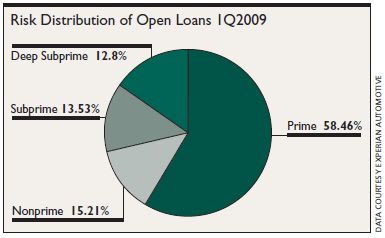
continued. For instance, while more than 58 percent of consumers with
automotive loans were considered prime, the category decreased by 2.6 percent
from the first quarter 2008.
Experiencing the greatest
growth in the first quarter was the deep subprime population, which increased
6.03 percent from the prior year. This resulted in 12.8 percent of consumers
falling into this high-risk category. Also increasing were the nonprime and
subprime segments, which saw increases of 3.08 percent and 1.87 percent,
respectively.
Ad Loading...
[PAGEBREAK]
Loans 60 Days Past Due
Increases in delinquency are
one of the leading causes of consumer credit shifts, and is one of the most
significant data points on which lenders focus. As lenders experience
increasing losses due to delinquency, the availability and details of lender
programs may change, impacting the credit programs available to dealers.
As seen over the last several
quarters, the trend of increasing delinquency continued in the first quarter
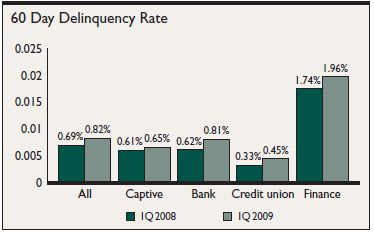
2009. Loans 60 days delinquent reached 0.82 percent during the measurement
period, an increase of 19.5 percent from the prior year. Not only did the rate
of 60-day delinquency increase, but the outstanding dollar balance increased by
more than 21 percent, resulting in more than $5.7 billion in loans reported 60
days delinquent.
Credit unions, which
represent 23 percent of all open automotive loans, had the lowest rate of
60-day delinquency, yet experienced the greatest increase in delinquency rates
(36.9 percent). The segment’s lower rates of delinquency resulted in it having
the lowest at-risk balance of 60-day delinquent loans ($663 million).
Ad Loading...
Banks accounted for nearly 37
percent of all open automotive loans and had the second highest rate of 60-day
delinquency at 0.81 percent, an increase of 31.7 percent from the prior year.
Due to their high market penetration and rising delinquency rates, banks had
the greatest at-risk loan balance with more than $2 billion in automotive loans
reported 60 days delinquent.
Credit Scores by Vehicle Type
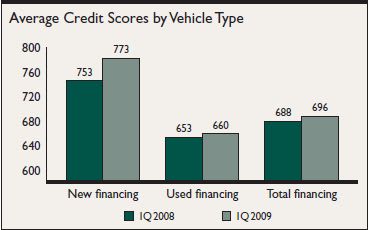
The trend of tightening
credit continued in the first quarter 2009, as seen with the increase in
average credit scores for both new- and used-vehicle financing. The average
credit score for vehicles financed in the first quarter was 696, an increase of
eight points.
New-vehicle financing
experienced a 20-point increase in scores, resulting in an average credit score
of 773. Used-vehicle financing, which didn’t tighten as much as new financing,
also saw an increase of seven points resulting in an average used-vehicle score
of 696 during the quarter.
[PAGEBREAK]
Ad Loading...
Credit Distributions by Vehicle Type
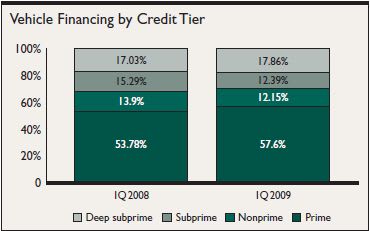
Along with higher credit
scores, the overall distribution of new-vehicle financing leaned significantly
toward consumers in the prime risk segment. However, both new- and used-vehicle
financing saw increases in the prime segment of more than 10 percent from the
prior year.
Higher risk consumers, while
still finding financing in the automotive space, had greater penetration in the
used-vehicle market. But while more than 53 percent of used-vehicle financing
was found outside of the prime market, the higher risk segments did contract
from the prior year. In fact, the most significant reduction in the
used-vehicle finance market was the subprime segment, which shrunk 17.05
percent from the previous year (new financing saw a 35.66 percent reduction).
The highest risk segment,
deep subprime, represented 20 percent of used-vehicle financing and only 1.56
percent of new-vehicle financing. The most significant reduction was seen in
new financing, with more than 48.7 percent fewer loans being financed. Used
financing, however, experienced an increase of 3.2 percent in this high-risk
category.
Average Amount Financed
Ad Loading...
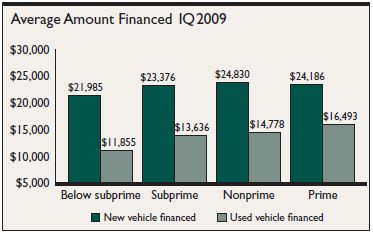
The average amount financed
in the first quarter 2009 for new vehicles was $24,176, a decrease of $606 from
the prior year. Used-vehicle financing decreased by $1,259, bringing the
average amount financed on a used loan to $15,320.
Across the risk tiers,
new-vehicle financing varied little as credit changed. The highest amount
financed on new vehicles was seen in the nonprime population, which averaged
$24,830, a decrease of $858 from the prior year.
As credit scores changed,
used-vehicle financing experienced greater deviations. Prime consumers financed
approximately $4,638 more than below subprime consumers in the used market.
However, the used market experienced the greatest decreases in the amount
financed. The largest of these decreases was seen in the subprime segment,
which fell by $2,079. This resulted in consumers within this segment financing
on average $13,636.
[PAGEBREAK]
Average Term
Ad Loading...
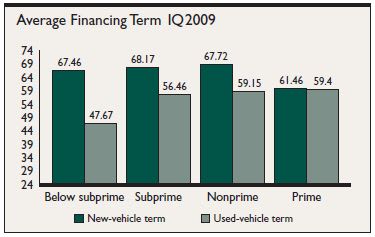
Across all risk tiers, the
average loan term for the first quarter was 59 months. While terms vary
considerably by credit tiers, each risk group saw considerable decreases in
monthly terms — with used-vehicle financing experiencing the greatest
reductions.
The average term for
new-vehicle financing across all risk tiers was 62 months, with the longest
terms held by the higher risk loans. However, despite having longer terms,
these segments experienced the greatest term contraction for new financing.
Below subprime saw a reduction of 1.42 months, resulting in an average term of
67.46 months. Subprime new loans fell by 1.15 months, bringing the average term
to 68.17 months. Nonprime and prime loans also experienced reductions of 0.82
and one month, respectively.
The average term for
used-vehicle financing across all tiers was 57 months, with higher risk loans
experiencing the most dramatic decreases in terms. Below subprime decreased
5.83 months to an average of 47.67 months, the shortest term for used-vehicle
financing. Subprime decreased 4.47 months and nonprime experienced a 2.72-month
decrease.
Used financing for prime
consumers, while holding the longest used term (59.4 months), also saw a
decrease of 1.63 months over the prior year.
Market Unpredictability to Continue
Ad Loading...
Vehicle financing continues
to experience noticeable and notable shifts in the market. While auto loans
were originated across all risk tiers, considerable changes were made to
financing based on vehicle type. Additionally, lenders continue to tighten
their financing criteria as delinquencies increase. If the shifts outlined in
this analysis reveal anything, it’s that the changes in lending trends are
unprecedented and a bit unpredictable.
The used-vehicle market is a
good example of this volatility, as it appears to have been impacted more
dramatically by loan characteristics. In contrast, new-vehicle financing
constricted considerably, as seen with the shifts in lending to higher credit
scores.
These continued changes in
the market will present ongoing challenges for the F&I manager, as lenders
continue to evolve their finance programs based on market conditions. Having a
firm understanding of these changes will be an F&I manager’s best chance at
knowing how lenders are reacting to the market and where they need to shift
strategies to best work with lenders in their market.
Melinda Zabritski serves as the director of automotive
credit for Experian Automotive. She can be reached at melinda.zabritski@bobit.com.
Auto loan originations rose over 6% year-over-year in the third quarter of 2025, but TransUnion predicts a slight decline in auto loan growth this year, making it an outlier in the company's overall lending forecast.
December brought some of the best borrowing availability for consumers in years, though lenders tightened their reins on riskier segments of the market.