


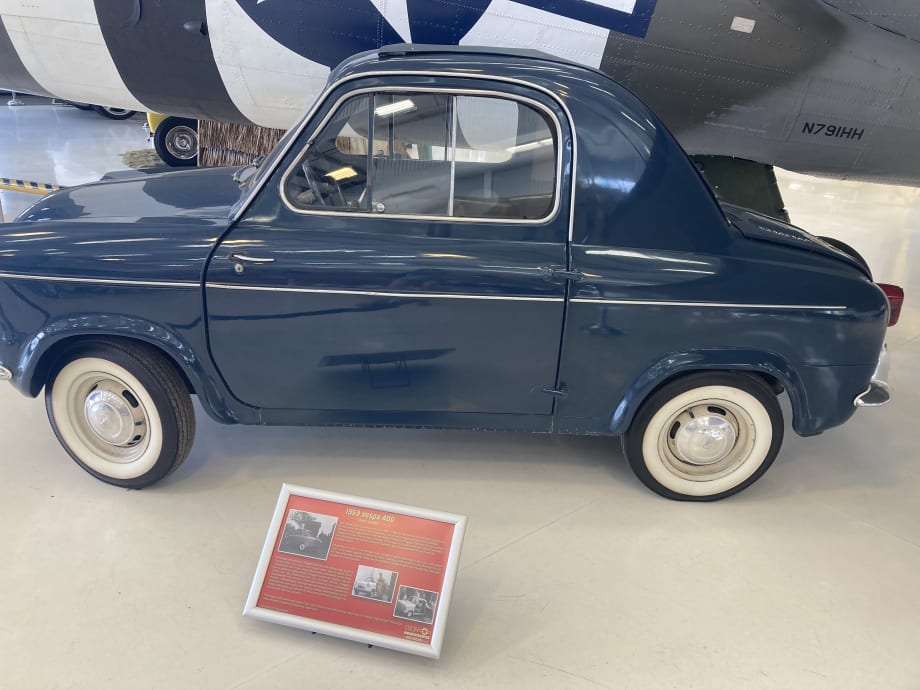
I recently checked out a microcars exhibit at the Lyon Air Museum next to John Wayne Airport in Santa Ana, Calif.
I’ve always wanted a vintage car, so this was right up my alley, and the collection of tiny cars didn’t disappoint me or three friends I took along.
Right next to the runway, the hangar where the museum is located showcased an interesting intersection of aviation and automobiles, the microcars nestled among the antique aircraft collected by the late Maj. Gen. William Lyon, who headed the Air Force Reserve Command.
The assembled autos represented the rise of the microcar after World War II, when more easily maneuverable miniatures gained traction due to Europe’s tight urban streetscapes and their lighter fuel consumption. American, German, Italian and French automakers churned them out for war-weary consumers as weather-proof alternatives to popular motorcycles on the continent.
Specimens included a blue 1959 Autobianchi Bianchina Trasformabile convertible by the Italian car maker, at all of 10 feet and 2 inches long; a two-toned 1942 Crosley by Cincinnati-based Crosley Motors; and a green 1959 Fiat 600 Multipla that looked like a cross between a minivan and a Volkswagen beetle.
The microcars stood in stark contrast in more ways than one to a large touring car originally owned by Adolph Hitler that sits in a back corner year-round at the museum. The 1939 Mercedes Model G4 Offener wagon, complete with a bullet-proof windshield and pistol holders throughout, was seized by the French Army near the Austrian border, according to the museum.
Hitler apparently wasn’t concerned about fuel economy, but I wish we were here in the states today. Mini cars still are popular in Europe and in many Asian cities. The U.S., on the other hand, has gravitated to oversize pickups and SUVs, which grew in number when interest rates were low and consumers took advantage of their elevated safety factor. In crashes, though, they’re more dangerous for pedestrians and occupants of smaller vehicles.
Small, meaning today’s regular-size cars and compacts, not microcars like the 1959 Vespa 400 displayed at the museum. Despite the brand name, French company ACMA produced the model for Italian scooter brand Piaggio, which entered the microcar segment with the 8½-foot-long 400.
U.S. automakers would do well to produce more smaller models, if not microcars, for overseas markets that don’t go for the domestic behemoths big enough to carry small armies. As for myself, I wouldn’t take the 400 on L.A.’s freeways!
LEARN MORE: Tariff Tea Leaves Sad


